Would you rather wheel: 30 questions to load, and how to keep a spin fair
2026-11-08
This post contains affiliate links. As an Amazon Associate, ZAGO.TO earns from qualifying purchases.

Twelve kids, one question list, and the same hand going up every time. A would you rather wheel fixes the part of the game that usually goes wrong: who answers, and which question comes next.
This guide has 30 ready questions sorted by age, two ways to set the wheel up, and the small bit of math that explains why a question keeps coming back when you did not expect it.

▲ When the wheel picks, nobody argues that the teacher chose the hard question for them
1. Two ways to build the wheel
There are two setups, and most of the "would you rather spinner" searches are really asking which one to use.
| Setup | What goes on the slices | Best for | |---|---|---| | Question wheel | The questions themselves, one per slice | Parties, family dinners, long car rides | | Player wheel | Names of the people playing | Classrooms, ESL lessons, team meetings | | Both | One wheel for names, one for questions | A group of 8 or more who will play for 20+ minutes |
A question wheel replaces the printed list. Nobody reads ahead, and the next question is a surprise for everyone, including the person running the game.
A player wheel keeps the questions with you, on paper or a slide, and lets the wheel decide who answers.
In a classroom this is the more useful one, because the quiet students get called as often as the loud ones.
With both, spin the names first, then the questions. It sounds like extra work, but it takes about five seconds per round once the two lists are typed.
2. Thirty questions, sorted by age
Each one is short enough to read off a slice. Copy the group that fits, paste it one per line, and spin.
Ages 6 to 10
- Would you rather have a pet dragon or a pet unicorn?
- Would you rather be able to fly or be invisible?
- Would you rather eat pizza every day or ice cream every day?
- Would you rather live in a treehouse or a castle?
- Would you rather talk to animals or speak every language?
- Would you rather have no homework or no bedtime?
- Would you rather be a giant or the size of an ant?
- Would you rather swim with dolphins or ride an elephant?
- Would you rather have a robot friend or a talking dog?
- Would you rather live on the moon or under the sea?
Ages 11 to 15, or a classroom
- Would you rather read minds or see the future?
- Would you rather never use a phone again or never watch TV again?
- Would you rather be the best player on a losing team or the worst on a winning one?
- Would you rather go back in time or jump ahead 100 years?
- Would you rather be famous online or rich and unknown?
- Would you rather have summer all year or winter all year?
- Would you rather give a speech to 500 people or sing alone in class?
- Would you rather know every answer on a test or never need to sleep?
- Would you rather explore space or the deep ocean?
- Would you rather always be 10 minutes late or 20 minutes early?
Adults, office and family friendly
- Would you rather work a 4-day week or have 8 weeks of vacation?
- Would you rather never wait in line or never sit in traffic?
- Would you rather cook every meal or never cook again?
- Would you rather live in a big city or a small town?
- Would you rather have a personal chef or a personal driver?
- Would you rather give up coffee or give up dessert?
- Would you rather retire at 45 or work forever in a dream job?
- Would you rather be able to pause time or rewind it?
- Would you rather know how every movie ends or never get spoilers again?
- Would you rather have a free flight anywhere once a year or free groceries for life?
For ESL classes, groups 1 and 2 work well because each question uses only two short choices.
Ask students to answer with a full sentence: "I would rather fly, because…" That turns one spin into one practiced sentence with the "would rather" pattern.
3. Why the same question comes back
A fair wheel does not mean an even-looking game. With 30 equal slices and nothing removed, every spin has the same 1 in 30 chance for each question, and repeats arrive sooner than most people guess.
| Spins so far | Chance at least one question has repeated | |---|---| | 5 | 29.6% | | 10 | 81.5% | | 15 | 98.6% |
That is the birthday problem in a game. By the tenth spin, a repeat is more likely than not by a wide margin.
It takes about 120 spins on average before every one of the 30 questions has come up at least once, which is far longer than any party lasts.
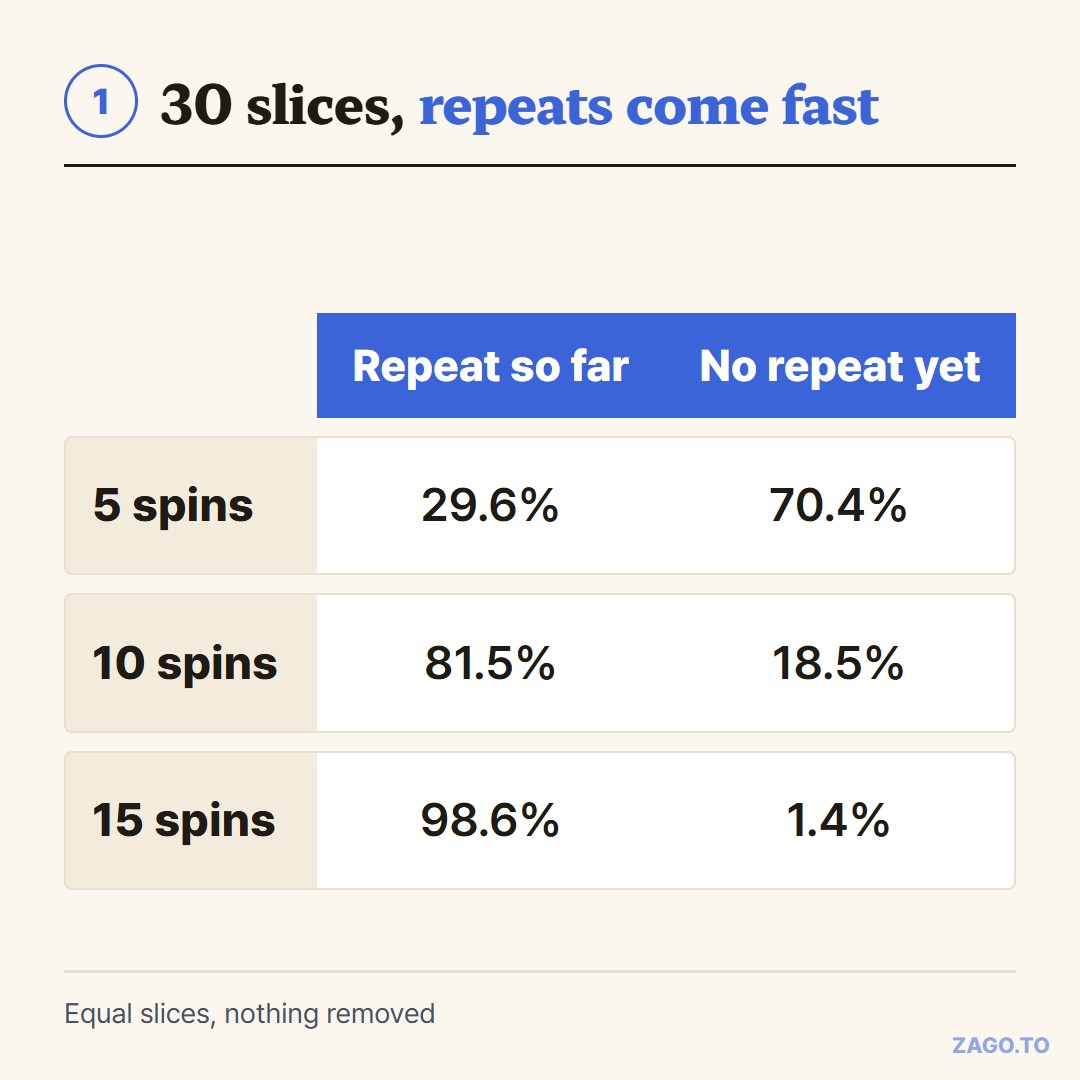
▲ Ten spins on 30 equal slices, and a repeat is already over 80% likely
The fix is to remove each question after it comes up. Then 30 spins give 30 different questions, and nothing repeats until you restore the list.
The same rule applies to a player wheel. Without removing names, one student can be picked three times in a lesson while another is never picked, and both of those outcomes are perfectly random.
4. Keeping a spin fair, step by step
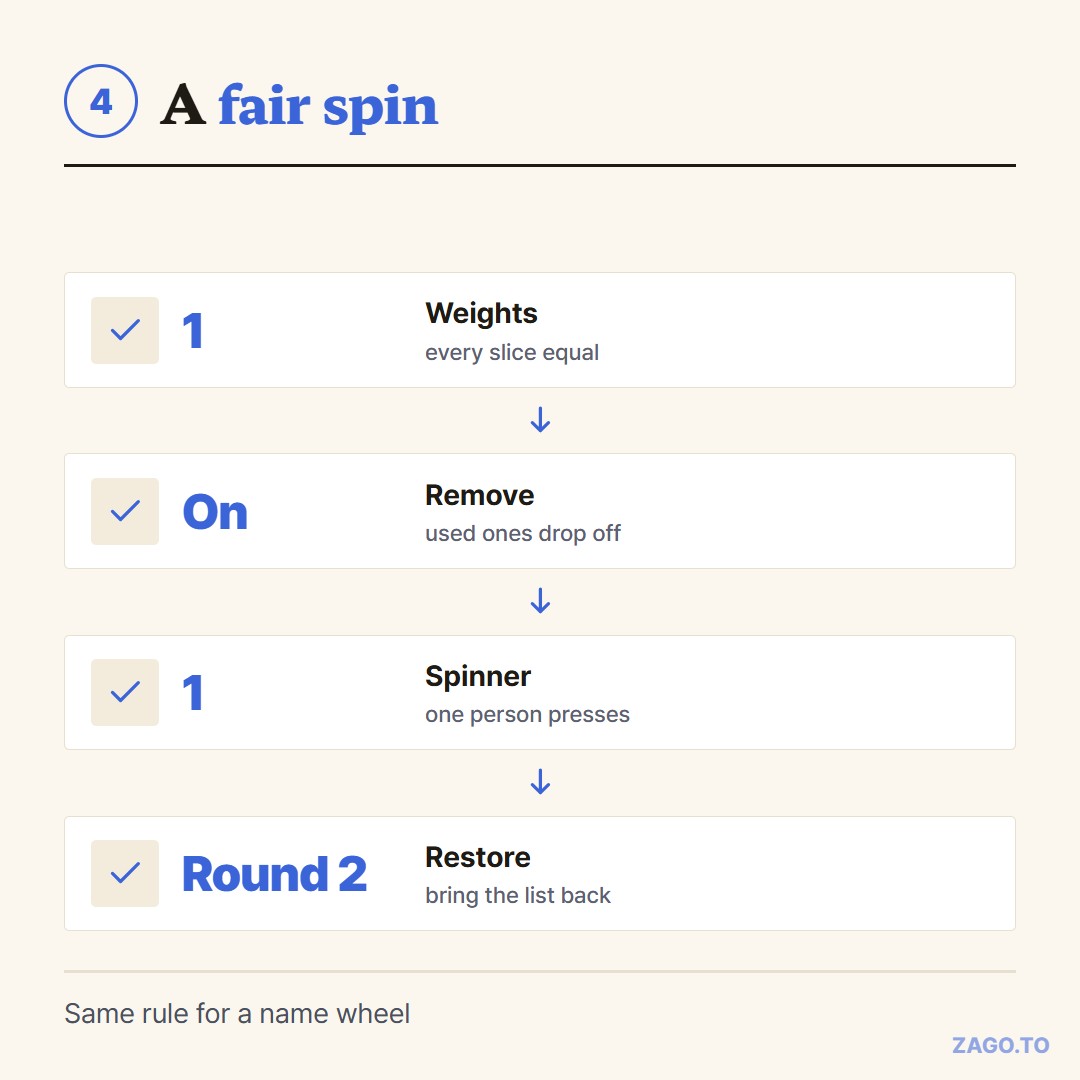
▲ Equal slices, remove after use, one spinner, restore between rounds
- Keep every slice equal. Leave the weight at 1 for all entries. Weights are for raffles, not for questions.
- Remove after each spin. Used questions and already-picked players drop off, so the game moves through the whole list.
- Let one person spin. The host or the teacher presses the button. When everyone spins on their own phone, each phone is its own game.
- Restore between rounds. When the wheel is empty, bring the full list back and start again.
One more house rule that helps with kids: everyone gets one pass. A wheel removes the argument about who answers, and a pass removes the pressure of a question someone really does not want.
5. Setting it up in a minute
Open the Wheel Spinner on ZAGO.TO, paste one question per line, and press spin. Turn on Remove winner before the first spin.
Restore removed brings the used entries back for round two, and the list is remembered on that device for next time.
Copy result link shares the entries and what came up in a group chat, which is handy when half the family joins by video.
What the ZAGO.TO wheel does not do is run a separate wheel on each player's phone. Everyone watches one screen, which for a classroom projector or a living room TV is usually what you want.
If wordwall or Wheel of Names is already set up in your school, those work fine for this too. Wordwall has ready-made activities to browse, and Wheel of Names is quick for a long list of names.
If your group likes this, the truth or dare wheel setup uses the same remove-after-use idea.
For calling on students, random name picker, and why removing the winner matters goes deeper on the classroom side.
Before the first spin
- Pick the age group and paste those 10 questions, or all 30
- Leave all weights at 1
- Switch on Remove winner
- Decide who presses spin
- Agree on one pass per player
Then load your list into the Wheel Spinner and let the wheel do the picking.
Other tools: Word Counter · Days Until
 Days until Christmas
 Word Counter
 Age Calculator
 Wheel Spinner