Truth or dare wheel: two slices or twenty prompts, and how to keep it kid-safe
2026-10-29
This post contains affiliate links. As an Amazon Associate, ZAGO.TO earns from qualifying purchases.

Who goes next, and is it truth or dare? At a sleepover or a party, that argument eats more time than the game. A truth or dare wheel settles both in one spin.
There are two ways to build one, and they suit different groups. Below are both setups, the odds behind each, starter prompts by age, and the four rules that keep a dare wheel safe for kids.
1. The two-slice wheel
Put two entries on the wheel: Truth and Dare. Each player spins on their turn and answers whatever comes up.

▲ The wheel decides, so nobody can say the host picked the hard dare for them
This is the fastest setup. It takes ten seconds and works for any age, because the actual questions still come from the group.
If the group is shy, change the odds instead of the rules. Give Truth a weight of 2 and Dare a weight of 1, and dares drop to one spin in three. For a bolder crowd, flip it.
The share of dares is simply the Dare weight divided by the total weight.
| Truth weight | Dare weight | Dares come up | Good for | |---|---|---|---| | 1 | 1 | 1 spin in 2 | a group that knows each other well | | 2 | 1 | 1 spin in 3 | mixed ages, a first sleepover | | 3 | 1 | 1 spin in 4 | shy players, family game night | | 1 | 2 | 2 spins in 3 | older teens who find truths boring |
A weight does not promise a pattern. At 2 to 1, three dares in a row still happens about once in 27 tries.
So tell the group before the first spin that streaks are normal and nobody rigged anything.
2. The prompt wheel
The other setup puts the prompts themselves on the wheel: "Truth: your most embarrassing text" or "Dare: talk in an accent for two turns". Twenty entries is a good size.
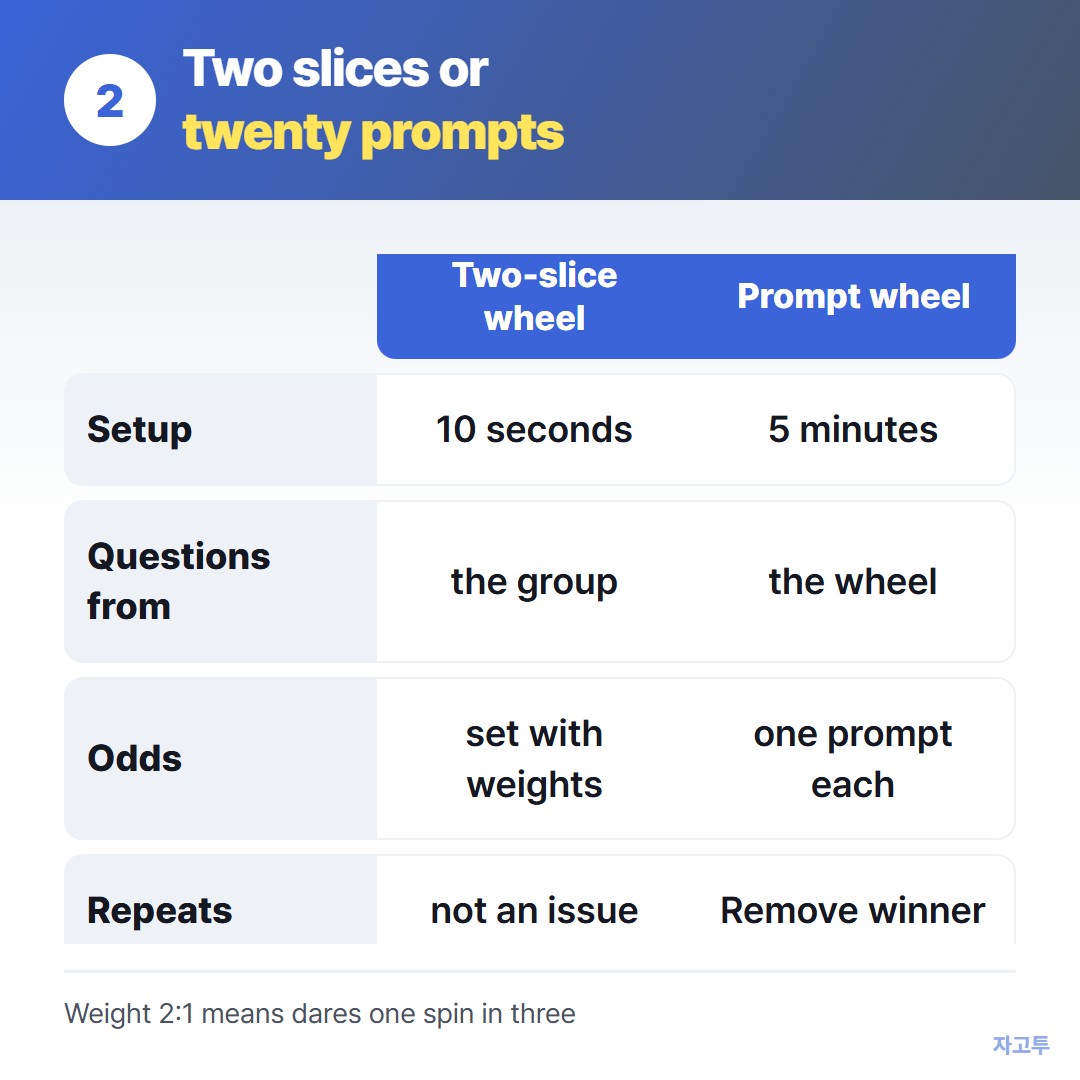
▲ Two slices for speed, twenty prompts for a game nobody has to invent
This is what the "truth or dare spinner with questions" searches are after. The catch is repeats, and they come sooner than most people expect.
On a wheel of twenty equal slices, the chance that at least one prompt lands twice is about 42% after only five spins.
After eight spins it is 80%, and after ten it is 93%. With five players, that means a repeat is almost certain by the end of round two.
Switch on Remove winner and each prompt drops off once it is used.
Twenty prompts and five players then gives exactly four turns each, with no repeats. When the wheel is empty, restore it or write a new round.
### Starter prompts by age
Mix truths and dares about half and half, and write them for the youngest person in the room. These are safe starting points, and the group can swap in its own.
| Age | Truth | Dare | |---|---|---| | 7 to 10 | What is the funniest thing you ever did at school? | Hop on one foot until your next turn | | 7 to 10 | Which food would you never eat again? | Sing the alphabet backwards as far as you can | | 11 to 13 | What is the last thing you searched for? | Talk in an accent for two turns | | 11 to 13 | Who in this room would survive longest on a desert island? | Do your best impression of a teacher | | 14 and up | What is the most embarrassing text you ever sent? | Let the group pick your profile picture pose, phone stays in the room |
Keep each entry short. A long sentence gets squeezed on a twenty-slice wheel, so "Dare: accent, 2 turns" reads better on the slice than the full instruction.
3. Keeping dares kid-safe
The searches split into "for kids", "for teens" and "extreme". The most watched videos are the extreme ones, and that is exactly what a child has seen before the party.
Write the wheel for the youngest person playing, and check it before the party starts.
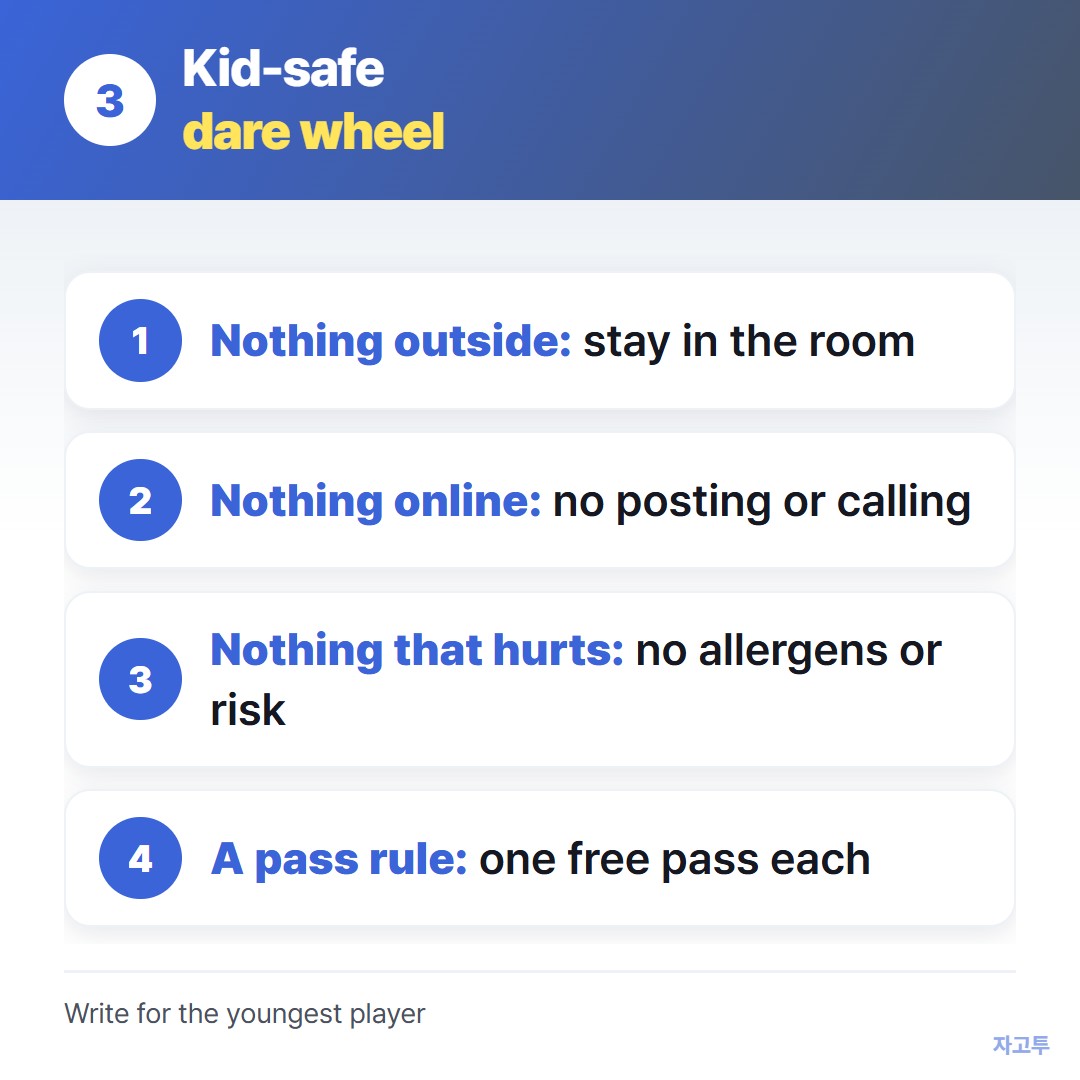
▲ Read every slice once before the first spin
- Nothing outside: no dares that leave the house or the room
- Nothing online: no posting, messaging or calling people who are not playing
- Nothing that hurts: no food dares with allergens, no physical risk
- A pass rule: everyone gets one free pass, no questions asked
The moment that usually goes wrong is a refusal. One child lands on a dare, freezes, and the room starts chanting.
The pass rule exists for that moment. With Remove winner on, a passed prompt simply leaves the wheel and the next spin moves the game along, so nobody has to argue about it.
Truths need the same check as dares. A question about crushes or family can sting more than any dare, so read the truth slices with the same eye.
If kids add their own entries during the game, an adult reads each new slice before it goes on.
4. Setting it up
Open the free Wheel Spinner on ZAGO.TO, type one entry per line, and spin. Weights and Remove winner are both in the options.
The entries stay in that browser, so the same wheel is there next weekend.
It runs on one device, though, so players share one screen rather than spinning on their own phones. For a video call, one person shares their screen and spins for everyone.
For turn order, a second wheel with everyone's names and Remove winner on works too. Each name comes up once per round, so the loudest player cannot take extra turns.
Random name picker, and why removing the winner matters explains why that keeps turns even.
A paper version works as well: write prompts on slips and draw from a bowl.
That is the better choice when phones are put away for the night. The wheel earns its place when the group wants weighted odds or a fresh round without rewriting twenty slips.
The short version: two slices for a quick game, a prompt wheel with Remove winner for a long one, and read every dare before the kids do. Build yours in the Wheel Spinner.
Other tools: Days Until · Word Counter
 Days until Christmas
 Word Counter
 Age Calculator
 Wheel Spinner