Prize wheel spinner for a booth or raffle: slice math so the big prize stays rare
2026-11-08
This post contains affiliate links. As an Amazon Associate, ZAGO.TO earns from qualifying purchases.
How many grand prizes do you actually have, and how many people will spin? Answer those two questions before you build a prize wheel spinner, and the rest is simple arithmetic.
Skip them, and the usual thing happens at a school fair or a trade show booth. The wheel looks fun, and the big prize lands three times in the first hour.
By lunch you are explaining to a ten-year-old why "grand prize" now means a sticker.
This guide works through the slice math with real numbers, compares a cardboard wheel with a screen, and ends with a short checklist you can run the night before.
Contents
- Start from the prize box, not the wheel
- What a common 8-slice wheel really gives away
- A 20-slice setup that lasts the day
- Weights instead of repeated slices
- Cardboard wheel or screen
- When a prize runs out
- The night-before checklist
1. Start from the prize box, not the wheel
Count what you are giving away. Then guess how many spins you expect.
A booth that sees a steady line for four hours often gets somewhere around 150 to 250 spins, but your own event is the only real guide, so use last year's headcount if you have one.
Now divide. If you have 10 grand prizes and expect 200 spins, the grand prize should come up about 1 time in 20. That is 5%.
The odds come from the prize box. The wheel just has to match them.
The same goes for the middle tier. Fifty small prizes over 200 spins is 1 in 4, or 25%. Everything left over goes to a consolation slice: candy, a sticker, a pen with your logo on it.
For a crowd with kids, a consolation prize works better than "try again", because nobody walks away with nothing.

▲ The wheel should match the prize box, not the other way round
2. What a common 8-slice wheel really gives away
A very common homemade layout is 8 slices: 1 grand prize, 3 small prizes, 4 "try again". It looks balanced. Here is what it does over a 200-spin day.
| Slice | Slices | Chance per spin | Expected in 200 spins | |---|---|---|---| | Grand prize | 1 of 8 | 12.5% | 25 | | Small prize | 3 of 8 | 37.5% | 75 | | Try again | 4 of 8 | 50% | 100 |
If you packed 10 grand prizes, the wheel expects to use them up after about 80 spins. That is often before the busiest part of the day.
This is the most common way a prize wheel goes wrong, and it is not bad luck. The layout simply gives away more than the box holds.
3. A 20-slice setup that lasts the day
Rebuild the wheel from the numbers in section 1.
| Slice | Weight or slices | Chance per spin | Expected in 200 spins | |---|---|---|---| | Grand prize | 1 | 5% | 10 | | Small prize | 5 | 25% | 50 | | Candy | 14 | 70% | 140 |
Expected is not guaranteed. Random spins bunch up. For a 5% grand prize over 200 spins, the binomial numbers look like this:
- Chance the wheel lands on the grand prize more than 10 times: about 42%
- More than 12 times: about 20%
- More than 14 times: about 8%
So plan a small buffer. Either keep two or three extra grand prizes in reserve, or set the grand prize a little lower, at 4% (1 in 25).
At 4%, the wheel expects 8 grand prizes in 200 spins, and the chance of going past 10 drops to about 18%.
Bunching works the other way too. At 5%, there is about a 36% chance that nobody hits the grand prize in the first 20 spins, and about an 8% chance of a 50-spin dry spell.
If the line starts to grumble, that is normal randomness, not a rigged wheel. Saying the odds out loud ("1 in 20 wins the big one") helps a lot here.
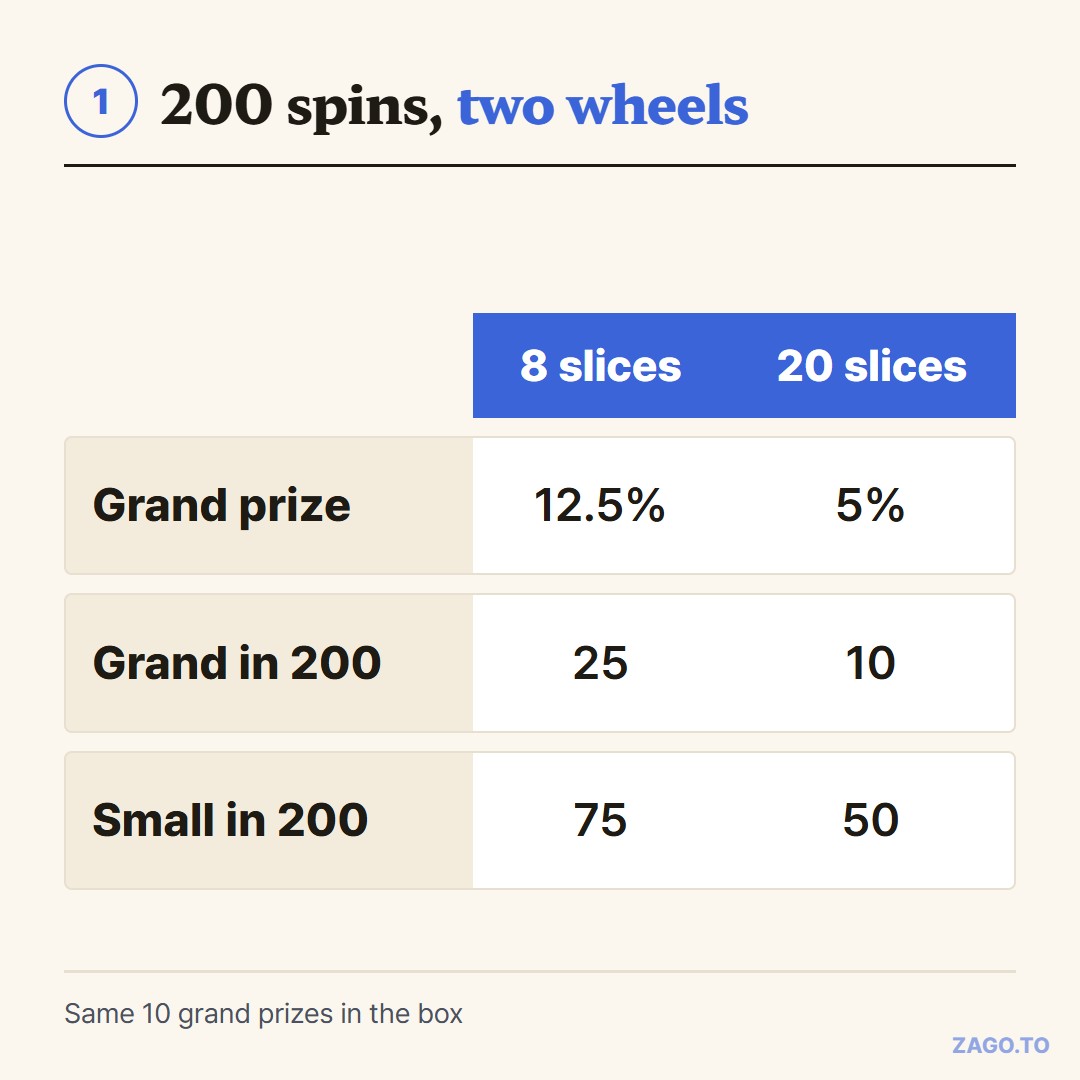
▲ Same prize box, very different day
4. Weights instead of repeated slices
There are two ways to make the candy slice 14 times more likely than the grand prize.
Repeat the slice. Type "Candy" 14 times. This works on any wheel, including a printed one, but the list gets long and it is easy to miscount.
Use a weight. Type each prize once and give it a number: grand prize 1, small prize 5, candy 14. The wheel adds them up (20) and each prize gets its share.
On the Wheel Spinner at ZAGO.TO, each entry has a weight box, and the slices resize to match.
A weight of 1 next to a weight of 14 looks thin on purpose, so visitors can see the big prize is rare before they spin.
That is fairer than a wheel with eight equal-looking slices where the odds are hidden.
A quick check before the event: add up all the weights, then divide each one by the total. If the grand prize line does not come out near the percentage from section 1, fix it now.
5. Cardboard wheel or screen
The most-watched prize wheel videos are DIY builds: cardboard, a lazy Susan, nails as pegs, a flapper on top. They are worth it if the wheel itself is part of the show.
| | Cardboard or bought wheel | Screen wheel | |---|---|---| | Crowd appeal | Strong, people love the clicking | Good on a large TV or tablet stand | | Changing odds | Repaint or relabel slices | Change a number | | Fairness | Can stick or favor heavy sides | Even every spin | | Cost | Materials or purchase | Free | | Power and Wi-Fi | Not needed | Needs a charged device |
A physical wheel has a weakness people rarely mention: it is rarely perfectly balanced.
A heavy section, a loose peg or a warped board can make one area come up more often than its size suggests. If you build one, spin it 50 times at home and tally the results.
A screen picks the winner by the numbers you set. It does not drift, and nobody can nudge it with a slow push.
Plenty of booths use both: the cardboard wheel for looks, the tablet for the actual result. If an online wheel such as Wheel of Names is already set up for your team, it works too.
What matters is that the odds match the prize box.
6. When a prize runs out
Sooner or later a tier empties. When the last grand prize goes, take that slice off the wheel.
On a screen wheel, Remove winner does it in one tap, and Restore removed brings it back the next morning.
Keep a tally on paper next to the wheel. The ZAGO.TO wheel shows each result and lets you copy a result link, but it does not track how many prizes are left in your box. That count is yours.
If people pay to spin, or the wheel is part of a raffle with tickets, the rules for games of chance vary by state and by venue. Check with the event organizer before the day.
A free spin for visitors is the simplest setup.
For a ticket raffle where you draw numbers rather than prizes, random number wheel: pick numbers without repeats covers that side.
And if you want the math of why a fair spin feels unfair, spin the wheel to decide explains it with lunches and chores.
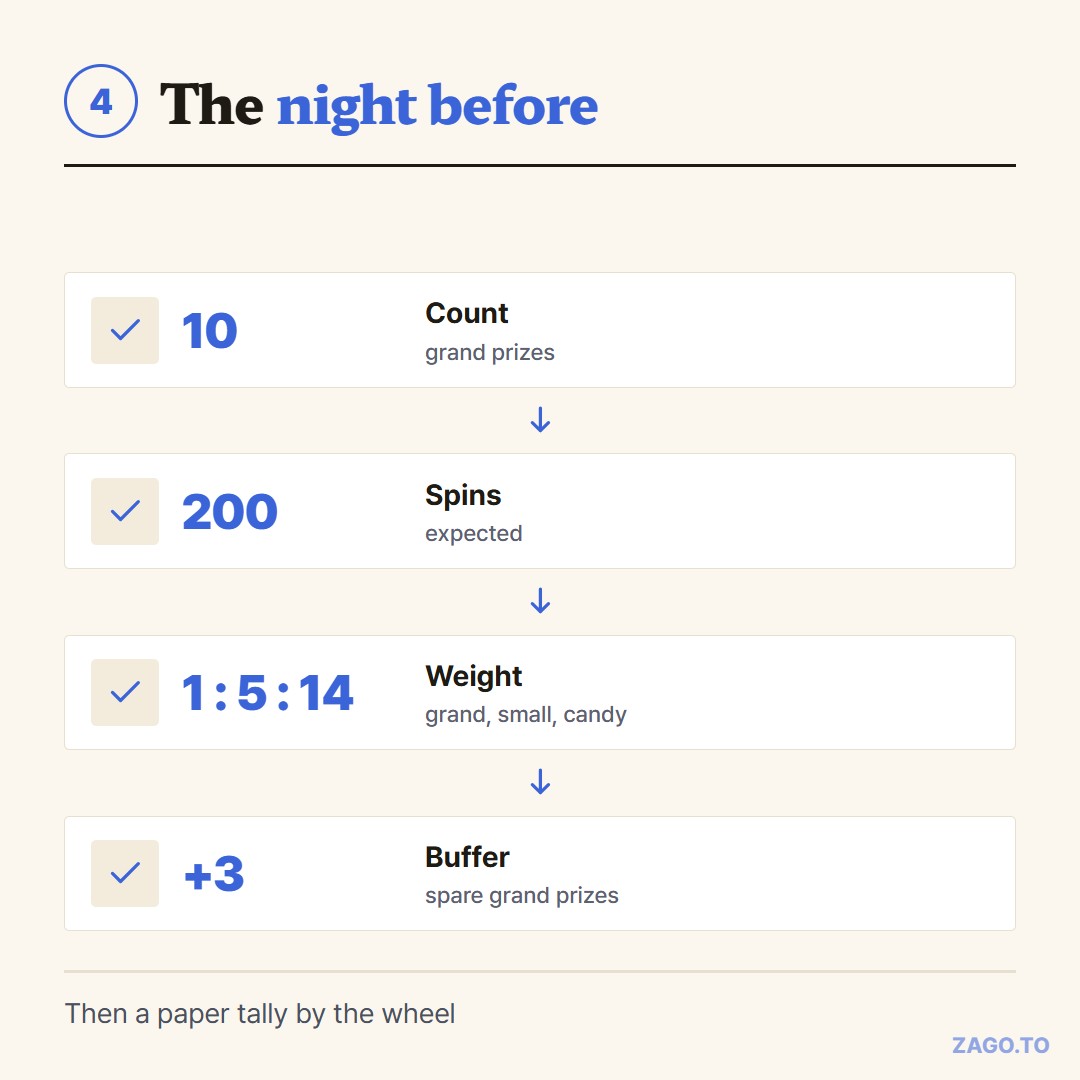
▲ Five numbers to settle before the doors open
7. The night-before checklist
- Count the prizes in each tier.
- Guess the number of spins, using last year if you can.
- Set each weight: prizes in the tier divided by expected spins.
- Keep 2 or 3 extra grand prizes, or set the grand prize a little lower.
- Spin 20 times at home and check nothing looks broken.
- Put a paper tally sheet next to the wheel.
- Decide who presses spin, and say the odds out loud.
Then load your prizes into the Wheel Spinner, set the weights, and open the booth.
Other tools: Days Until · QR Code Generator
 Days until Christmas
 Word Counter
 Age Calculator
 Wheel Spinner