Spin the wheel to decide: the math behind fair lunches, chores and raffles
2026-10-25
This post contains affiliate links. As an Amazon Associate, ZAGO.TO earns from qualifying purchases.

Four roommates, four chores, four spins of a plain wheel: there is a 91% chance someone ends up with two or more chores. Turn on "remove the winner" and that drops to zero.
When people spin the wheel to decide something, they usually care about one thing: nobody should be able to say it was rigged.
Most arguments do not come from the wheel being broken.
They come from how it was set up. Equal slices when the group wanted something else, the same name coming up twice, or a result posted to the group chat that nobody else saw happen.
This guide works through the numbers for the three most common uses, lunch, chores and raffles, and shows which setting fixes each problem.
Contents
- What actually decides the result
- Lunch: weights instead of equal slices
- Chores: why repeats are almost guaranteed
- Raffles: drawing prizes in order
- Sharing the result so nobody argues
- In three lines
1. What actually decides the result

▲ The arguing usually starts after the spin, not before
An online wheel spinner does not work like a physical wheel. When you press spin, the tool picks the winning slice at random first.
Then it animates the wheel for a few seconds so it lands on that slice.
That has two practical consequences.
- How hard or fast you tap makes no difference. The result is chosen the instant you press the button.
- A needle stopping right on a line is just the animation. The winner was already decided.
The odds come from one thing only: each entry's share of the wheel.
If every slice is the same size, every entry has the same chance. With six entries, that is one in six, about 16.7%, on every single spin.
The wheel has no memory. A name that just won is exactly as likely to win the next spin, unless you take it off the wheel. Most of the surprises below come from that one fact.
2. Lunch: weights instead of equal slices
Equal slices sound fair, but they ignore what the group actually wants. If three people want tacos, two want pizza and one wants salad, an equal wheel gives salad the same chance as tacos.
A weighted wheel fixes that. Give each entry a number, and its chance becomes that number divided by the total.
- Tacos 3, Pizza 2, Salad 1. Total: 6
- Tacos: 3 ÷ 6 = 50%
- Pizza: 2 ÷ 6 = about 33%
- Salad: 1 ÷ 6 = about 17%
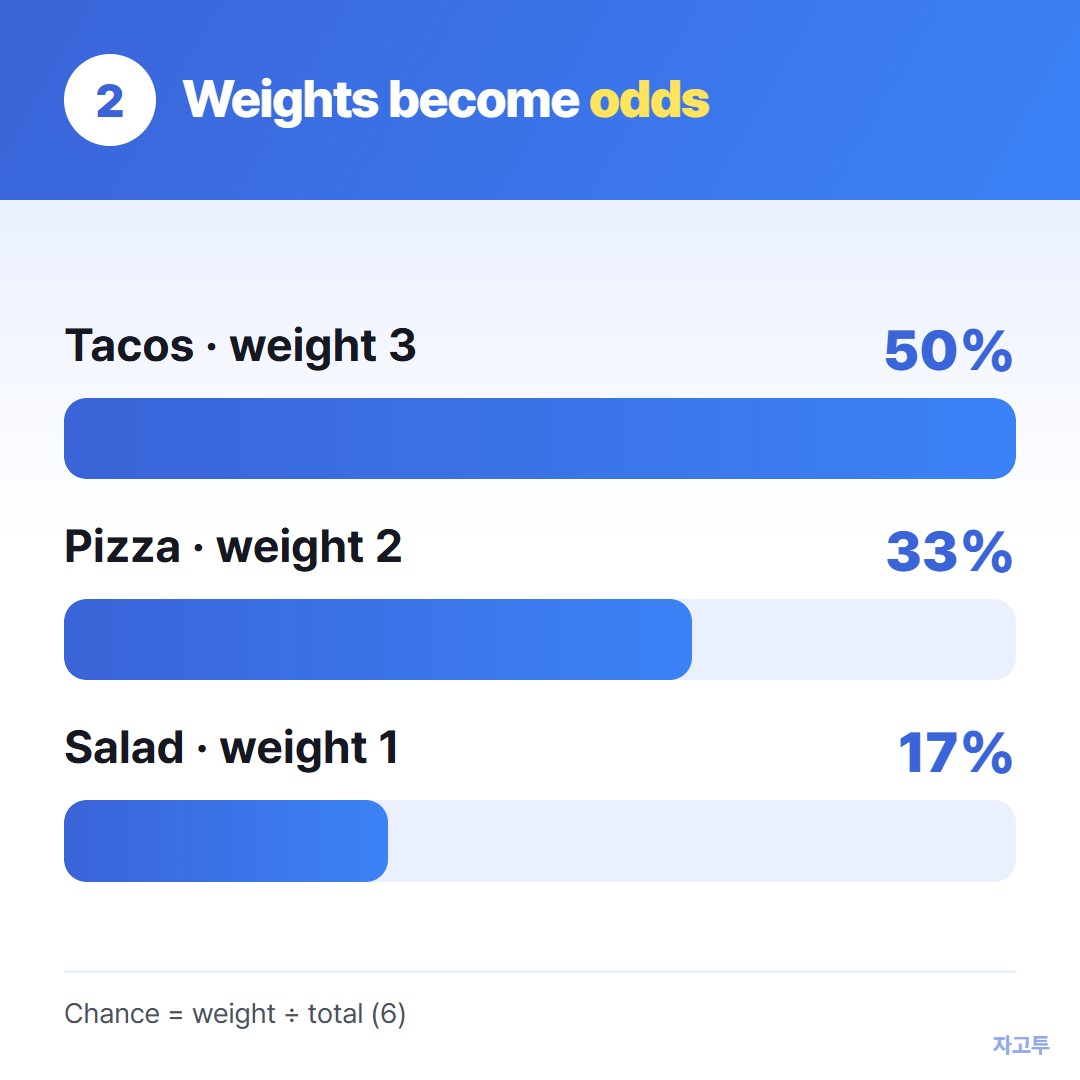
▲ Weight divided by the total is the chance of that slice
This is better than a straight vote. The minority choice still has a real chance, so the person who wanted salad is not simply outvoted every day.
Weights also handle the classic complaint, "we had that yesterday." Set yesterday's winner to 1 while everything else stays at 2, and its chance is cut roughly in half.
Set it to 0 and it drops off the wheel for the day.
In the Wheel Spinner on ZAGO.TO, the weight box sits next to each entry. Change the number and the slice resizes on the spot, so everyone can see the odds before the spin.
3. Chores: why repeats are almost guaranteed
Here is the case that surprises people most. Four roommates put their names on a wheel and spin once for each of four chores: dishes, trash, bathroom, vacuuming.
What are the chances that everyone gets exactly one chore?
- First spin: any name is fine. 4 out of 4
- Second spin: must be a new name. 3 out of 4
- Third spin: 2 out of 4
- Fourth spin: 1 out of 4
- All different: (4 × 3 × 2 × 1) ÷ (4 × 4 × 4 × 4) = 24 ÷ 256, about 9%
So about 91% of the time, at least one person gets two or more chores while someone else gets none. That is not bad luck. It is what a wheel with no memory does.
The same math hits lunch. With six options and five workdays, the chance that some option comes up twice in the week is also about 91%.
The fix is a setting, not a better wheel: remove the winner after each spin.
Spin once, that name drops off, and the next spin picks from whoever is left. Four spins, four different people, every time.
This is also how teachers pick presentation order or call on students without repeats.
Put the class list in, switch on remove winner, and keep spinning. When the wheel is empty, everyone has had a turn.
"Restore removed" puts every name back for next week.
4. Raffles: drawing prizes in order
For a small raffle at an office party or a club meeting, there are two ways to set up the wheel, and they suit different prizes.
Names on the wheel. Put each ticket holder on as an entry, switch on remove winner, and draw third prize first, then second, then first.
Nobody can win twice, and the tension builds toward the top prize.
Prizes on the wheel. The "Prizes (rare 1st)" preset loads four slices with these weights:
- 1st prize: 1 of 12, about 8%
- 2nd prize: 2 of 12, about 17%
- 3rd prize: 3 of 12, 25%
- Try again: 6 of 12, 50%
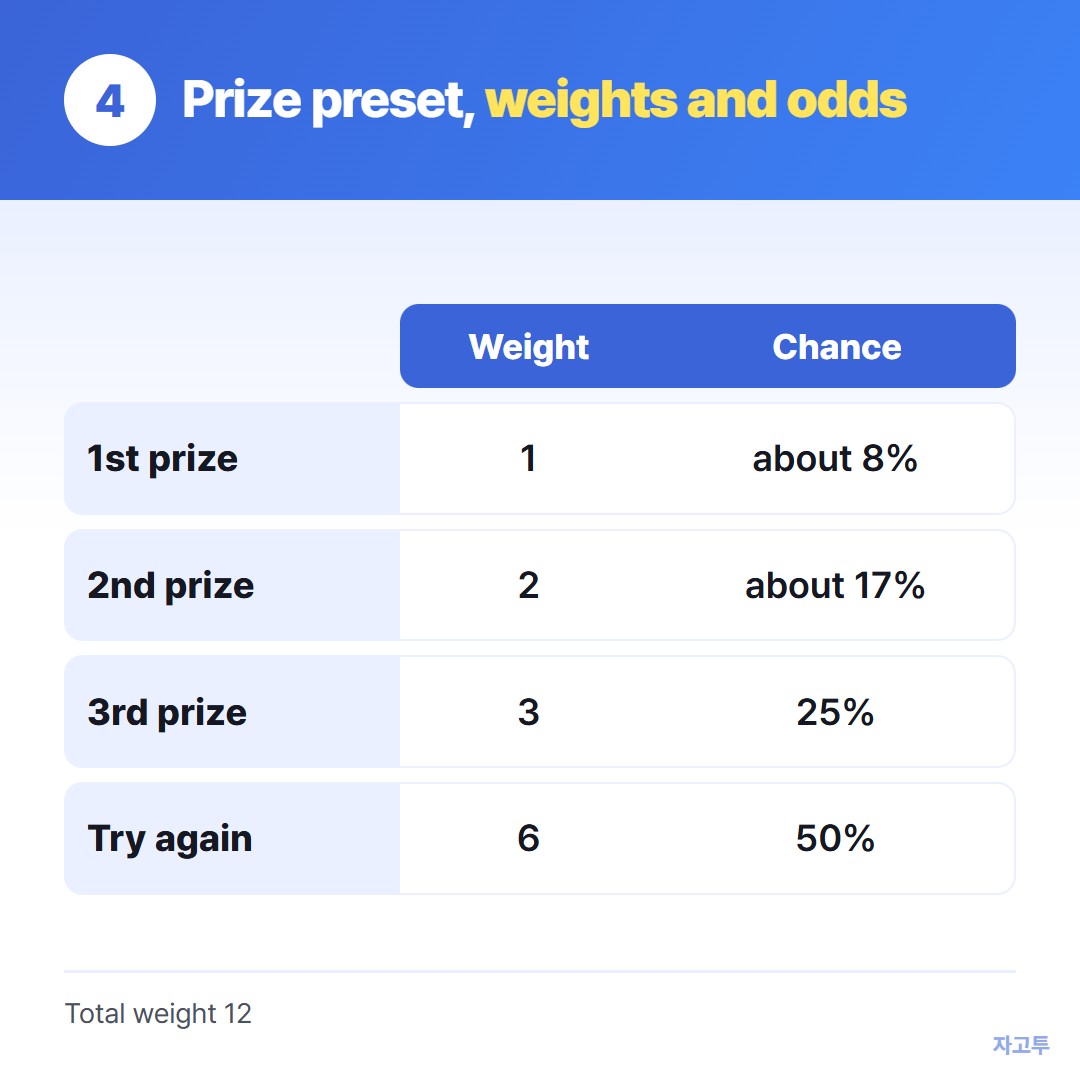
▲ Change any weight and the odds change with it
This suits a booth where each visitor spins once. The catch is that the odds never change, so the 1st prize slice can come up twice.
If you only have one grand prize, combine the two settings: once 1st prize comes up, it is removed.
A wheel spinner is a quick way to pick, not a record of the draw.
If your raffle sells tickets for money, local rules may require a documented drawing, and a phone screen in a meeting room will not count as one.
5. Sharing the result so nobody argues
Post the rules before you spin. Three lines in the group chat prevent most disputes:
- What is on the wheel, and at what weights
- Whether winners are removed
- That the first spin counts
After the spin, press Copy result link. The link carries every entry, every weight and the result that came up. Anyone who opens it sees the same wheel and the shared result.
One thing worth checking when you receive a link: look at the weight boxes. If one name has a 3 while everyone else has a 1, that is visible right there.
The link has a limit, and it is worth being honest about it. It shows what came up, not how many spins it took to get there.
Someone could spin until they like the answer and share only that.
If the stakes are real, spin once on a shared screen or a video call.
A few other limits:
- Up to 20 entries. A class of 30 or a list of 200 names needs a different tool. Wheel of Names handles big lists well and is the common pick for classrooms
- Entries are remembered on this device only. Open it on another phone and you start fresh
- No history. Past spins are not saved anywhere you can look up later
6. In three lines
- The result is decided the moment you press spin, so only slice size matters
- Use weights for preferences, and remove the winner whenever repeats would be unfair
- Post the rules first, then share the result link so everyone sees the same wheel
To try it with your own list, open the Wheel Spinner, type your entries, and set the weights before anyone spins.
More tools: Days Until · Word Counter
 Days until Christmas
 Word Counter
 Age Calculator
 Wheel Spinner