Chronological age calculator for testing: years, months and days, with borrowing explained
2026-10-29
This post contains affiliate links. As an Amazon Associate, ZAGO.TO earns from qualifying purchases.

The test date minus the birth date, written as years;months;days. When the days or months come out negative, you borrow from the column to the left. That is the whole method.
A chronological age calculator is the first thing a speech therapist, school psychologist or teacher reaches for before scoring a standardized test.
The norm tables in most test manuals are sorted by age bands like 6;10 to 6;11, so a one-month slip can put a child in the wrong row.
This guide shows the hand method step by step, the borrowing rule that trips people up, and where two correct methods give slightly different days.
1. A worked example, column by column
Write the test date on top and the birth date below it, in year, month, day columns. Then subtract each column from right to left.
- Test date: 2026 / 10 / 29
- Birth date: 2019 / 12 / 14
Days first: 29 minus 14 is 15. Months next: 10 minus 12 is negative, so the month column needs a borrow.
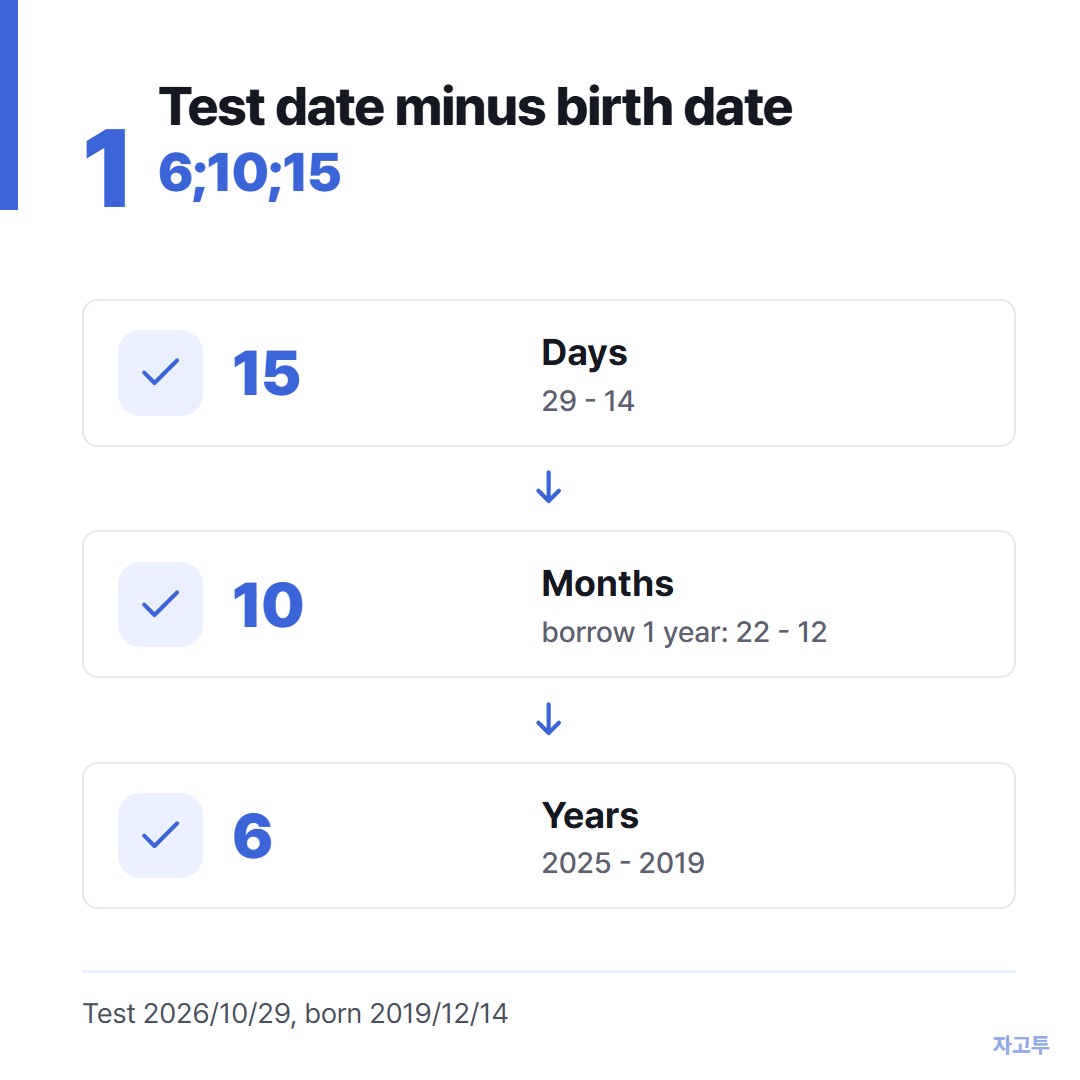
▲ Subtract days, then months, then years, borrowing when a column goes negative
Borrow one year, which is 12 months. The months become 22 minus 12, which is 10. The year becomes 2025 minus 2019, which is 6.
Chronological age: 6 years, 10 months, 15 days, written 6;10;15.
You can check it by counting forward: December 14, 2019 plus 6 years is December 14, 2025, plus 10 months is October 14, 2026, plus 15 days is October 29.
2. How to calculate chronological age when days go negative
This step causes most scoring errors. Go slowly. Take a test on March 5, 2026 for a child born July 20, 2018.
- Days: 5 minus 20 is negative. Borrow one month from the month column and add 30 days: 35 minus 20 is 15
- Months: March is now 2 after the borrow. 2 minus 7 is negative, so borrow a year: 14 minus 7 is 7
- Years: 2026 is now 2025. 2025 minus 2018 is 7
Result by hand: 7;7;15. Many test manuals tell you to borrow exactly 30 days, and this is that convention.
Now count it on a real calendar.
July 20, 2018 plus 7 years and 7 months is February 20, 2026. February 2026 has 28 days, so from February 20 to March 5 is only 13 days. The calendar answer is 7;7;13.
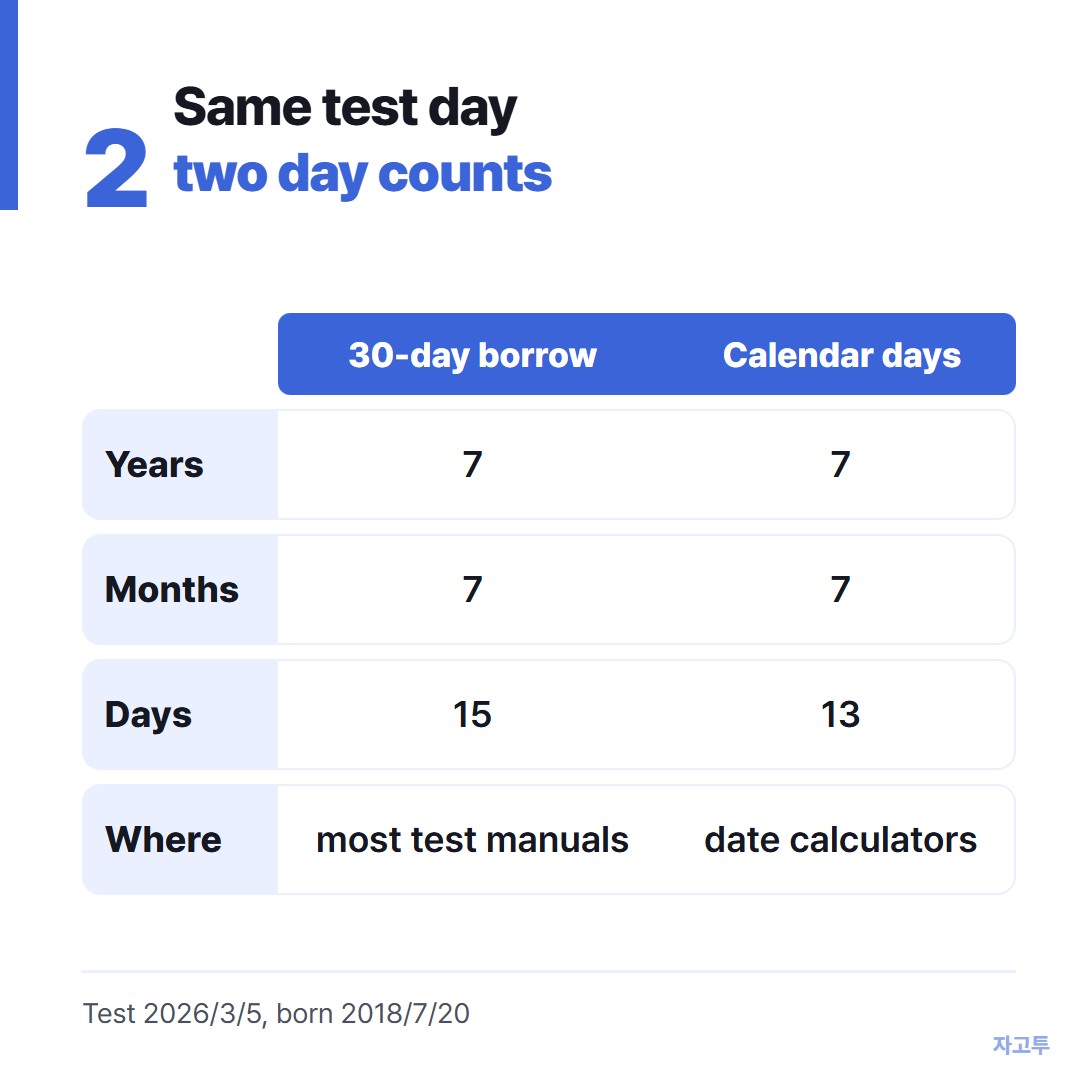
▲ Same child, same test day, two honest answers for the days
The years and months match, and that is what nearly every norm table uses.
The days only matter when your manual says to round. Some manuals round 15 or more days up to the next month, others say never round.
Follow the manual for the test you are giving, because the rule changes which row you read.
3. Chronological age vs adjusted age
For babies born early, many developmental assessments use adjusted age, also called corrected age. You subtract the weeks the baby was born before 40 weeks.
A baby born at 32 weeks is 8 weeks early. At a chronological age of 6 months, the adjusted age is about 4 months.
Clinicians usually stop adjusting around age 2, but the cut-off and the rounding depend on the assessment. Check its manual. It varies.
4. Doing it without the columns
If the test is today, ZAGO.TO has a free Age Calculator that shows years, months and days from a birth date, plus total days lived.
You type eight digits and read the answer.

▲ Handy for a test given today, but the manual's rounding rule still applies
A few honest limits for testing use:
- ZAGO.TO counts from today's date only. For a test given last week, use the hand method above
- It uses real calendar days, so for a case like section 2 it shows 13 days, not the 30-day convention
- It does not calculate adjusted age for prematurity
For why different tools sometimes split months and days differently, see Age calculator: exact age in years, months and days.
Common questions
Do I round chronological age up? Only if the test manual says so. Without that instruction, report years and months as calculated.
Which date do I use if testing takes two sessions? Most manuals use the date of the first session. Some say the date the test was completed. Write down which one you used.
Is chronological age the same as age in years? It is the same idea, measured more finely. A child who is 6 in years may be 6;0 or 6;11, and that difference matters for norm tables.
For a test happening today, open the Age Calculator. Other free tools: Days Until · Word Counter
 Days until Christmas
 Word Counter
 Age Calculator
 Wheel Spinner