Age calculator: why exact age in years, months and days is harder than it looks
2026-10-26
This post contains affiliate links. As an Amazon Associate, ZAGO.TO earns from qualifying purchases.

How old are you, exactly? Not "36," but 36 years, how many months, and how many days?
An age calculator answers that in a second, but two calculators can give you two different answers for the same birthday. The difference is never in the years.
It is in the months and days, because months are not the same length.
This guide walks through the math with worked examples, so you can check any result yourself, including the awkward cases: birthdays on the 31st and birthdays on February 29.
1. The simple part: completed years
In the US and most countries, your age is the number of birthdays you have actually had. Someone born on March 15, 1990 is 35 until March 14, 2026 and turns 36 on March 15, 2026.
The rule is short:
- Subtract the birth year from this year
- If this year's birthday has not happened yet, subtract one more
On October 26, 2026, that gives 2026 minus 1990, which is 36. The birthday in March has already passed, so nothing is subtracted. 36 years.
This part never causes arguments. Every calculator agrees on it.
Some countries have used other systems. South Korea, for example, long counted a newborn as one year old and added a year every January 1, and switched official documents to completed years in 2023.
If you see a "Korean age" option somewhere, that is what it means.
2. Months and days: a worked example
Now the full answer for the same person, born March 15, 1990, on October 26, 2026.
- Years: 36, as above. The last birthday was March 15, 2026
- Months: from March 15 to October 15 is 7 full months
- Days: from October 15 to October 26 is 11 days
Exact age: 36 years, 7 months, 11 days.
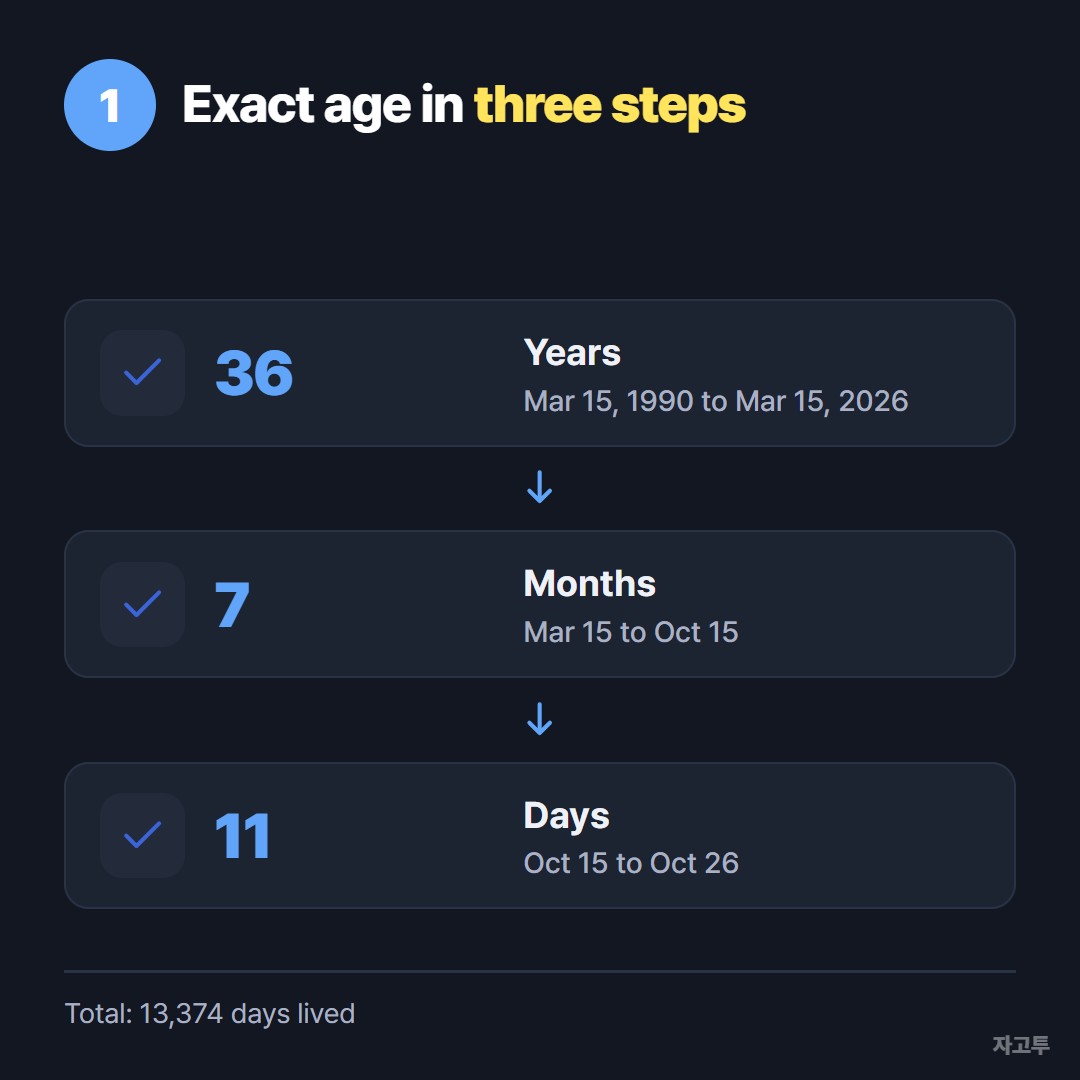
▲ Count years first, then whole months, then the days left over
The same person has lived 13,374 days, which is 1,910 weeks and 4 days. Days lived is the one number with no ambiguity at all, because it is just counting squares on a calendar.
If two tools disagree on months and days, compare their total days. If those match, they agree on the age and only differ in how they split it.
3. Why two calculators can disagree
The trouble starts when the birth day is larger than the number of days in a month.
Take someone born on January 31, 2000, and ask their age on March 1, 2026. The years are easy: 26, because January 31 has passed. But what about the rest?
- Method A, count forward by months. One month after January 31 would be February 31, which does not exist, so many tools push it back to February 28
- Method A result: from February 28 to March 1 is 1 day, so 26 years, 1 month, 1 day
- Method B, count the days. From January 31 to March 1, 2026 is 29 days, less than a full month by most definitions, so 26 years, 0 months, 29 days
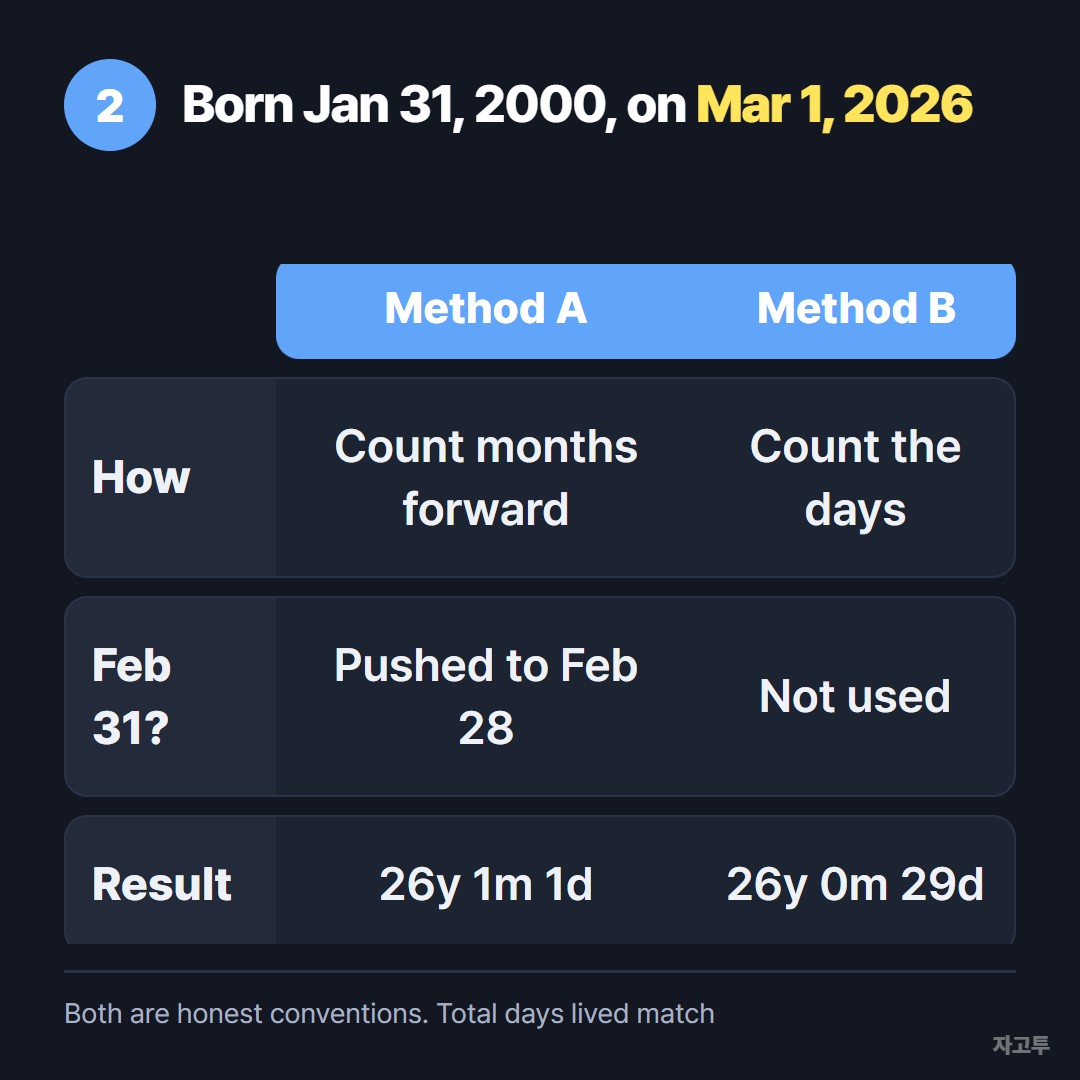
▲ Same person, same day, two honest answers
Neither answer is wrong. They are two conventions for a calendar that was never designed for clean subtraction.
Spreadsheets have the same issue, which is why the Excel formulas people search for often add an "MD" or "YM" argument to pick a convention.
It is the same story as word counters, where two tools count "e-mail" or a URL differently.
We covered that in Word counter: what counts as a word, and why tools disagree.
When it matters, for a form or a contract, use completed years and the exact birth date. Very few official forms ask for months and days.
4. February 29 birthdays
About one in 1,461 days is a February 29, so leap day birthdays are rare but not unusual. The next leap day is February 29, 2028.
In a common year, the question is when the birthday "happens." There are two habits:
- February 28: the last day of the birth month. Many people celebrate this day
- March 1: the day after February 28, the moment the full year has passed
For legal ages, like a driver's license or the drinking age, rules differ by country and state.
If a specific date matters, check the rule where you live rather than trusting any calculator, including ours.
Someone born on February 29, 2008 turns 18 in 2026, a common year. Depending on the rule, that is either February 28 or March 1, 2026. By the way, they have lived 6,814 days as of October 26, 2026.
5. Milestones worth knowing
Once you have the date of birth, a few milestones fall out of simple addition.
- 10,000 days old: a little over 27 years and 4 months. For the March 15, 1990 example, it was July 31, 2017
- 1 billion seconds old: about 31 years and 8 months. The same person passed it in November 2021
- The weekday you were born: March 15, 1990 was a Thursday
These are fun numbers for a card or a toast. They are also a quick way to test a calculator: if it gets the 10,000-day date wrong, it is probably off by a day somewhere else too.
6. Doing it without the arithmetic
If you would rather not count months on your fingers, ZAGO.TO has a free Age Calculator.
Type eight digits for the birth date, or scroll the wheels, and it shows years, months and days, total weeks and days lived, the next birthday, and the 10,000-day and 1-billion-second dates.

▲ Save the family once and every age stays current
You can save several people, parents, kids or friends, and see everyone's age on one screen. A few honest limits:
- ZAGO.TO keeps the saved list only on that device. It does not sync to your laptop
- For February 29 birthdays, the next birthday in a common year is shown on February 28
- It counts completed years. It does not calculate Korean age or legal ages for a specific state
In three lines
- Years are easy: count the birthdays you have had
- Months and days depend on a convention, so compare total days lived when tools disagree
- For leap day birthdays and legal ages, check the local rule
To check any date of birth now, open the Age Calculator. Other free tools: Days Until · Word Counter
 Days until Christmas
 Word Counter
 Age Calculator
 Wheel Spinner