Getting the same text to a room of people who share no app
2026-09-25
This post contains affiliate links. As an Amazon Associate, ZAGO.TO earns from qualifying purchases.
You are standing in front of twenty people. They need a link, or a command to paste, or a paragraph of setup instructions.
There is no shared channel. Some have the company chat, some do not. There is no mailing list for this group because the group only exists for the next ninety minutes. Asking everyone to install something is how you lose the room.
This situation shows up constantly in workshops, classrooms, onboarding sessions and conference talks, and there is no good default answer for it.
What people do now, and why each one stalls
Read it out. Works for a short URL and falls apart immediately for anything longer. Twenty people typing a random string produces at least three typos, and you will spend five minutes debugging them individually.
Write it on the whiteboard. Same problem, plus the people at the back cannot read it. Case-sensitive characters make it worse, because handwriting does not distinguish them clearly.
Put it on a slide. Better, and this is the usual answer. It works until the thing is long, or until someone arrives late, or until they need it again after you moved on.
A QR code on the slide. Genuinely good. Everyone points a phone at the screen and it opens. This is the strongest option when the content is a URL and the audience has phones out.
Where the QR code stops working is when the content is not a link. You cannot scan a paragraph of text into a clipboard on a laptop. And the people who need it on the laptop, not the phone, are stuck taking a photo and retyping.
Ask for emails. Now you are collecting personal data, you need a way to send, and it does not arrive during the session, which was the point.
A shared document. Good, and it needs a link to reach it, which puts you back at the previous problems, one layer removed.
What the room actually has in common
Almost nothing, except two things: everyone can read a projector, and everyone has a browser.
So the reliable channel is "something short on the screen plus a browser". That constrains the answer more than people realise. Whatever you put on the board has to be short enough to be copied by eye without error, and the destination has to be a plain web page.
Short enough to copy by eye means digits. Letters introduce case and lookalikes, and a URL introduces both plus punctuation. Numbers do not have those problems.
Where we fit, and the catch
This is our own service, so read the catch carefully because it is a real one.
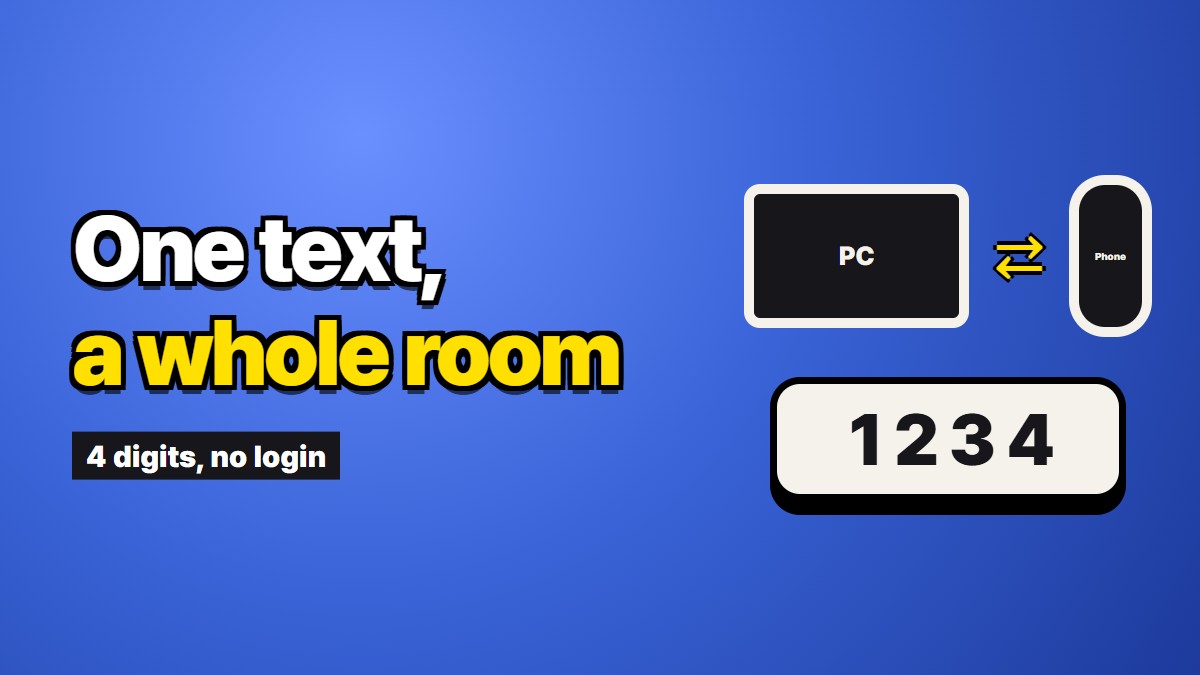
ZAGO.TO takes text and gives you four digits. Write those four digits on the whiteboard or put them on a slide, and each person opens the site and types them. The text appears in their browser, on whatever device they are using.
The catch: it is built for one recipient, not twenty. The text is deleted about a minute after it is first opened. If you give a code to a room, the first person opens it and starts a one-minute clock for everyone. People who are slower to type will find it gone.
That is not a bug we are planning to remove, because the short life is the point of the service. But it does mean this is a poor fit for a room unless you work with it deliberately.
Making it work anyway
If you want to use it for a group, there are two honest ways.
Tell the room to open it together. "Everyone go to the site now and type these four digits." A minute is enough if everyone starts at the same time. This works for a room of twenty when you have their attention. It does not work if people are drifting in.
Send it again. Paste, get new digits, write them up, and repeat for the stragglers. It takes a few seconds per round. Slightly inelegant and completely reliable.
If neither fits, use something built for persistence instead. A shared document, a page on your own site, or a pinned message in whatever channel most of the room does share. For a group, permanence is usually the feature you want, and we are the wrong tool for that on purpose.
What to be careful with in a room
Two things worth saying because a room is different from a person.
Anyone who can see the board can open it. A code written where twenty people can read it is a code that the person walking past the open door can also read. For a setup command or a link to public material that is fine. For anything you would not shout across the room, it is not.
And the content is on twenty screens now. Whatever happens on our end after a minute, twenty people can have copied it. That is true of anything you put in front of a group, and it is worth remembering when the instinct to use a disappearing tool makes you feel safer than you are.
The short version
A room of strangers shares a projector and a browser and nothing else. That makes four digits a surprisingly good carrier, and it makes anything with letters or punctuation a bad one.
Just be clear-eyed that a service built to forget after one reader is being pushed sideways when you use it for a crowd. For a group, either coordinate the timing or use something that keeps the text around.