SMS character limit: 160 in plain text, 70 once an emoji sneaks in
2026-11-06
This post contains affiliate links. As an Amazon Associate, ZAGO.TO earns from qualifying purchases.
You write a reminder for 40 customers. It is 150 characters, comfortably under the limit everyone quotes. Then the bill from your texting service shows three messages per person instead of one.
Nothing went wrong with the service. One smiley face at the end changed how the whole message was counted.
▲ The draft looked short, and the bill counted it three times
The SMS character limit is not one number. It is two numbers, and a third and fourth once a message gets long.
This guide walks through all of them with a worked example, so you can see the split coming before you press send.
Contents
- The two limits: 160 and 70
- What pushes a text from 160 down to 70
- Long messages: why 153 and 67, not 160 and 70
- Worked example: one emoji, three messages
- Is the limit different in the UK, India or Australia?
- Checking a draft before it goes out
1. The two limits: 160 and 70
A single SMS carries 140 bytes of text. How many characters fit into those 140 bytes depends on the alphabet your phone uses to encode the message.
- GSM-7, the standard texting alphabet, uses 7 bits per character. 140 bytes is 1,120 bits, and 1,120 divided by 7 is 160 characters.
- UCS-2, the Unicode fallback, uses 16 bits per character. 1,120 divided by 16 is 70 characters.
Your phone picks the alphabet for you. If every character in the message exists in GSM-7, you get 160. If even one character does not, the whole message switches to UCS-2 and you get 70.
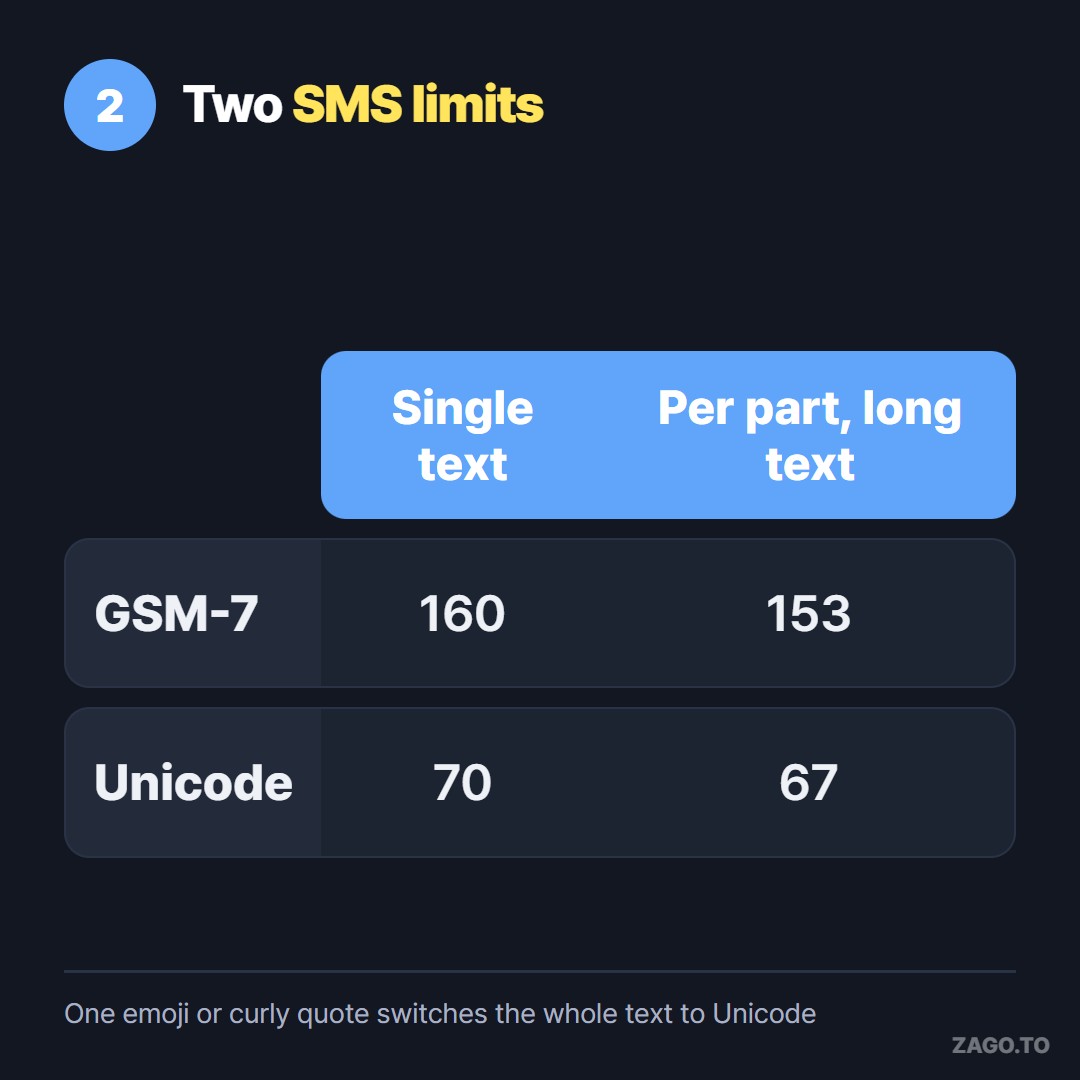
▲ Same 140 bytes, two alphabets, two very different limits
That last point is the one people miss. It is not "70 for the emoji part." One character outside GSM-7 drops the limit for the entire message.
2. What pushes a text from 160 down to 70
GSM-7 covers the English alphabet, digits, common punctuation and a set of European letters such as é, è, ü, ñ and ö. A lot of everyday characters are missing from it.
| Character | In GSM-7? | What it does to your message | |---|---|---| | Plain letters, digits, `. , ! ? ' "` | Yes | Counts as 1, limit stays 160 | | é, è, ü, ñ, ö, Ä | Yes | Counts as 1, limit stays 160 | | á, í, ó, ú | No | Switches the message to 70 | | Curly quotes ’ “ ” | No | Switches the message to 70 | | Any emoji | No | Switches to 70, and most emoji use 2 of those 70 | | € [ ] { } ~ ^ and the backslash | Extended set | Stays 160, but each one counts as 2 |
Two rows on that table cause most surprises.
Curly quotes. Phones and word processors replace straight apostrophes with curly ones as you type.
If you write a message in a document or an email first and paste it into a texting tool, "don't" may arrive as "don’t," and that single curly apostrophe costs you 90 characters of room.
Emoji. Most emoji sit outside the basic Unicode range, so they are stored as two 16-bit units. A message with one emoji has 68 characters of room left in a single SMS, not 69.
The extended set row is the quieter one. Characters like the euro sign or square brackets stay in GSM-7, but each needs an escape code, so it takes two of your 160.
3. Long messages: why 153 and 67, not 160 and 70
When a text runs past the limit, your phone splits it into parts and the receiving phone stitches them back together. To do that, each part carries a small header that says "part 2 of 3."
That header takes 6 bytes of the 140, which eats into the text.
- In GSM-7, each part of a long message holds 153 characters
- In UCS-2, each part holds 67 characters
So a 161-character plain message is not "160 plus 1." It is two parts of up to 153, and 306 characters fit before you need a third.
| Message length (GSM-7) | Parts | Message length (Unicode) | Parts | |---|---|---|---| | 1 to 160 | 1 | 1 to 70 | 1 | | 161 to 306 | 2 | 71 to 134 | 2 | | 307 to 459 | 3 | 135 to 201 | 3 | | 460 to 612 | 4 | 202 to 268 | 4 | | 613 to 765 | 5 | 269 to 335 | 5 |
On a personal phone plan that includes texting, none of this changes what you pay.
It matters for business texting services that bill per part, and for older phones where long messages can arrive split or out of order.
Many phones also turn a long text into an MMS automatically after a few parts. That is a setting on the phone and a choice by the carrier, so it varies from one device to the next.
4. Worked example: one emoji, three messages
Here is the reminder from the start, character by character.
This is Lakeside Dental. Your cleaning is on Tue Nov 17 at 3:30 PM. Reply C to confirm or R to reschedule. Call 555-0142 with questions. See you soon!
That is 150 characters, all in GSM-7. One part.
Now the person writing it adds a smiley at the end, with a space before it.
- The message switches to UCS-2, so the limit is 70, or 67 per part once it is long
- The text is now 150 characters, plus 1 space, plus 1 emoji stored as 2 units, for 153 units
- 153 divided by 67 is 2.28, so it needs three parts
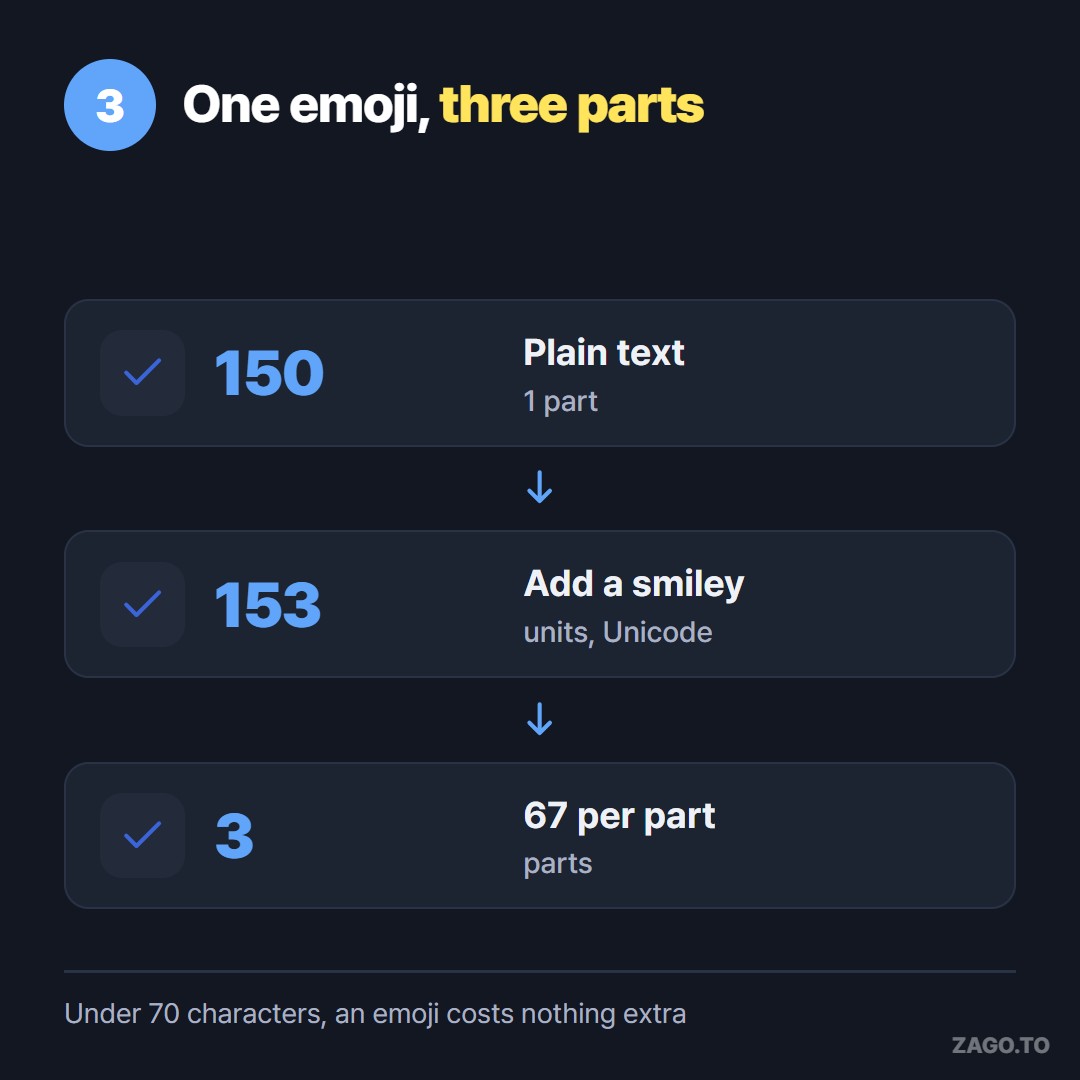
▲ 150 characters, then a space and a smiley, then three parts
Across 40 customers, that is 120 billed parts instead of 40, for one character nobody needed.
The fix is not to strip all warmth from your texts.
It is to know which version you are sending. Under 70 characters, an emoji costs nothing extra. Over 70, decide whether it is worth tripling the count.
5. Is the limit different in the UK, India or Australia?
The autocomplete for this question fills with country names, so here is the short answer: no.
The 160 and 70 limits come from the GSM standard that mobile networks use worldwide, and they are the same in the US, the UK, India, Australia and almost everywhere else.
What does differ by country is the rules around business texting.
- Senders in some countries must register a sender name or template before sending bulk messages
- Some networks cap how many parts a single long message can have
- Carriers can choose whether to convert long texts to MMS
Business texting platforms set their own caps on top of this. Twilio, for example, documents a limit of 1,600 characters per message.
If you send at scale, the platform's own documentation is the place to check.
Chat apps are a different system entirely. iMessage, WhatsApp and RCS chats in Google Messages are sent over data, not as SMS, so these limits do not apply to them.
The 160 rule only matters when the bubble turns green on an iPhone, or when the text goes out through a carrier's SMS channel.
6. Checking a draft before it goes out
Counting by hand past 50 characters is not realistic. Paste the draft into a counter first.
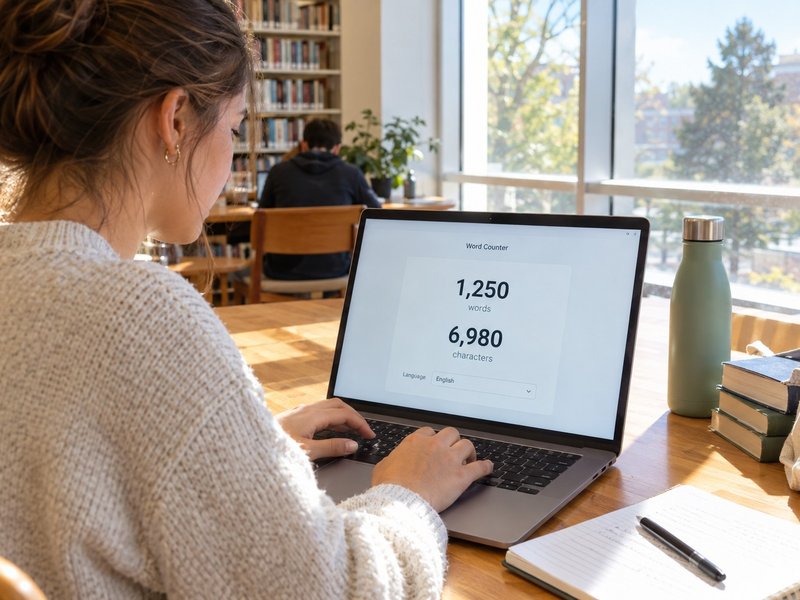
The Word Counter on ZAGO.TO shows characters as you type, with and without spaces, and it also shows UTF-8 bytes.
That second number is a quick test for the problem in this guide.
Plain English letters, digits and basic punctuation take 1 byte each in UTF-8.
If the byte count is higher than the character count, something in the draft is not plain text, often a curly quote, an accented letter or an emoji. Find it, and decide if it stays.
To be straight about what it does not do: it counts characters, not SMS parts, and it does not tell you which alphabet your phone will pick.
For an exact part count, a dedicated SMS segment calculator such as the one Twilio publishes is the better tool.
The counter is the fast first look, and the draft autosaves on your device while you trim.
For how other platforms count, including X and Meta, see character counter limits for X, SMS and Meta.
Posts on X have their own rule where some characters count as two, covered in how many characters in a tweet.
Checklist before you send a text to many people
- Under 160 characters, with no emoji, curly quotes or á í ó ú
- If it has any of those, under 70 characters
- Straight apostrophes, not curly ones, if you pasted from a document
- Euro signs and brackets counted as two
- Longer than one part? Count 153 or 67 per part, not 160 or 70
Paste the draft into the Word Counter and compare characters with bytes before it goes out.
Other tools: QR Code Generator · Days Until
 Days until Christmas
 Word Counter
 Age Calculator
 Wheel Spinner