Self-destructing messages online: what to expect from any of them
2026-10-05
This post contains affiliate links. As an Amazon Associate, ZAGO.TO earns from qualifying purchases.
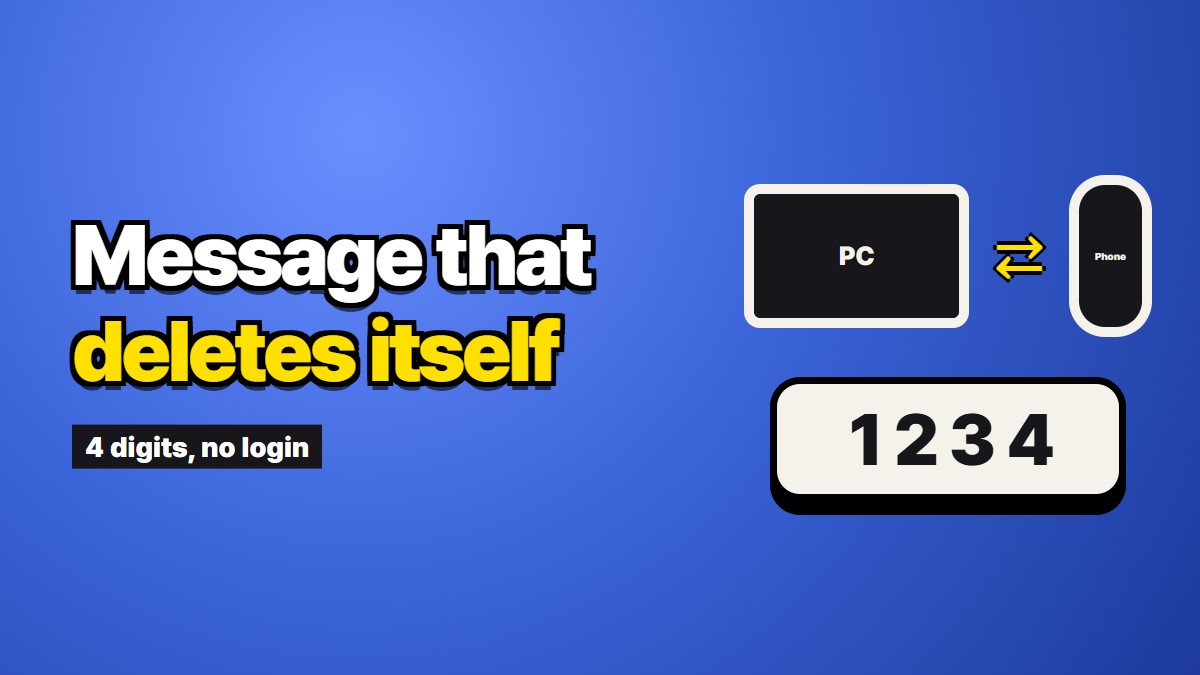
A self-destructing message sounds like a spy film, and the most watched videos on the phrase are still the "this message will self destruct" scenes. In real life the idea is smaller and more useful. You send something, it is readable for a short while, and then the service deletes it. Telegram, WhatsApp, Discord and iMessage all have some version, and there are websites that do it for a single note or link.
Before you rely on any of them, it helps to know what "self-destructing" can and cannot mean. This applies to every service, including ours.
Three questions to ask any self-destructing message
When does the clock start? Some services count from when the message is sent. Others count from when it is first opened. Many use both: a long timer for an unread message and a short one once it is read. The difference matters. A note that vanishes ten seconds after opening is useless if the reader is still finding their glasses.
What exactly is deleted? Usually the copy on the service's server, and the copy in the app. Not the reader's screenshot, not the text they pasted somewhere else, not the notification preview that may have flashed on a lock screen. No service can reach into the other person's head or camera roll.
Who could read it before it was deleted? This is the question people skip. If the service can read the message while it sits on its server, then "self-destructing" describes how long it exists, not who can see it. Some messengers are designed so the company cannot read the content. Many simple note websites are not.
How the clocks work on ZAGO.TO
ZAGO.TO is built for moving a piece of text from one device to another with a 4-digit code, and the self-destructing part is two short clocks:
- If nobody opens the code, the text is deleted after one minute.
- Once it is opened, it stays readable for one more minute, then it is deleted. Within that minute it can be opened again.
So the longest any text sits on the server is about two minutes. Once deleted, it cannot be brought back, and the code is not handed out again for five minutes. The full reasoning for picking one minute is in Why one minute, and the exact meaning of deleted is in What deleted means here, precisely.
On the third question, the honest answer is that our server can read the text while it is there. There is no browser-side protection yet. That makes it fine for an address, a link, or a paragraph you want on your other screen, and the wrong place for passwords, keys, or anything you would not want a stranger to read.
When a self-destructing message is the wrong tool
If the reader needs the text next week, a self-deleting note is a trap. Send it somewhere it will stay. If the content is truly secret, the deletion timer matters less than who can read it in the meantime, so pick a messenger designed so the company cannot read it, and know that the other person can still copy it. And if what you need to move is a file rather than text, a note service is not the answer at all; ours only carries text.
The short version
A self-destructing message limits how long something exists, not who sees it. Ask when the clock starts, what is deleted, and who could read it first. Then pick the service whose answers fit what you are sending.