How many days until winter 2026? December 1 or December 21, and when winter ends
2026-11-07
This post contains affiliate links. As an Amazon Associate, ZAGO.TO earns from qualifying purchases.
There are two right answers to how many days until winter, and they are three weeks apart.
From November 7, 2026, it is 24 days until December 1, the start of meteorological winter. It is 44 days until Monday, December 21, the winter solstice and the start of astronomical winter.
Which one you want depends on why you are asking. A weather app, a school calendar and an astronomy club will each give you a different "first day of winter," and none of them is wrong.

▲ Two start dates, three weeks apart, both called the first day of winter
Winter 2026 at a glance
| Question | Date | Days from Nov 7, 2026 | |---|---|---| | Meteorological winter starts | Tuesday, December 1, 2026 | 24 | | Winter solstice (astronomical start) | Monday, December 21, 2026 | 44 | | Meteorological winter ends | Sunday, February 28, 2027 | 113 | | Spring equinox (astronomical end) | Saturday, March 20, 2027 | 133 |
The counts above are calendar days, counting from November 7 and not counting the target day.
If you are reading this later, subtract the days that have passed, or let a counter do it for you (more on that below).
1. Why there are two first days of winter
Astronomical winter is set by the Earth's tilt. In the Northern Hemisphere it begins at the December solstice, the moment the North Pole is tilted farthest from the sun.
In 2026 that moment falls on December 21 at 20:50 UTC, which is 3:50 p.m. Eastern and 12:50 p.m. Pacific. It ends at the March equinox, on March 20, 2027.
Meteorological winter is set by the calendar. Weather services group the year into three-month seasons so that records line up neatly from year to year.
Winter is December, January and February, every time.
So if you hear a forecaster say "winter starts Tuesday" on November 30, and an astronomer say it starts on the 21st, both are describing the same season with a different ruler.
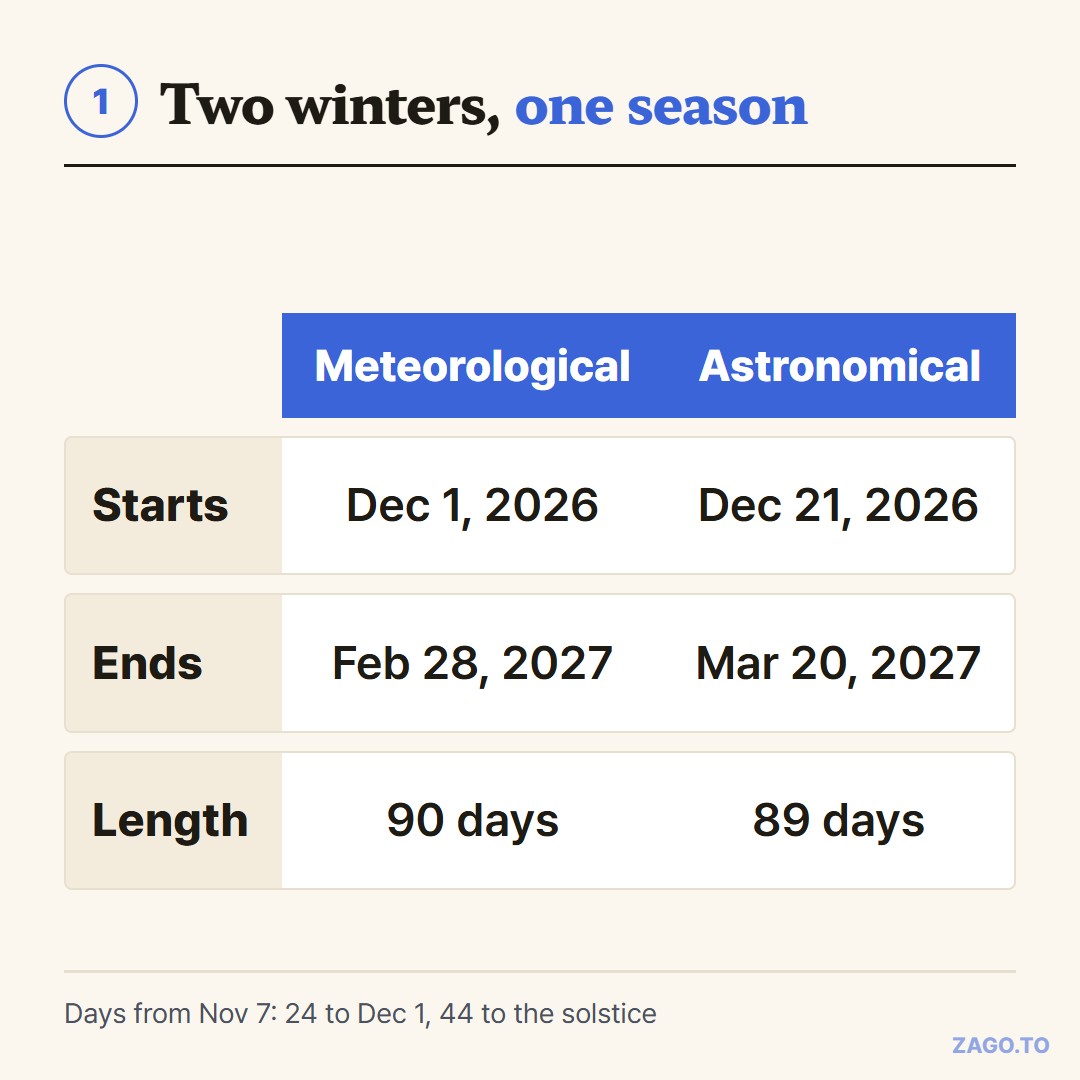
▲ Meteorological winter runs 90 days this year, astronomical winter runs 89
The lengths differ by a day this time.
Meteorological winter runs 90 days (December 1 through February 28, since 2027 is not a leap year). Astronomical winter runs 89 days, from December 21 to March 20.
2. When winter ends, and the question behind it
Autocomplete for this topic keeps asking "how many days until winter is over." That usually means one of three things.
- The calendar end of meteorological winter: February 28, 2027
- The astronomical end: the spring equinox on March 20, 2027
- The end of the cold: no date for that. In much of the northern US, March is still winter weather whatever the calendar says
If the question is really "when do the evenings get lighter," the answer is sooner than most people think. Here is the part that surprises people.
The shortest day of the year is not the day with the earliest sunset.
Around 40 degrees north, roughly the latitude of New York, Philadelphia, Denver and Salt Lake City, the earliest sunsets come in the first half of December. The latest sunrises come in early January.
The solstice sits between them as the day with the least total daylight, a little over nine hours in New York.
That happens because of the shape of the Earth's orbit and its tilt, which shift solar noon a little later each day in December.
The practical result is that by Christmas, evenings are already a minute or two longer than they were in mid-December, even though mornings are still getting darker.
3. Days until winter break, which is a different count again
The other big question in this search is winter break, and that one has no national date. Every district sets its own.
A common pattern is a last school day on the Friday before Christmas week and a return on the first Monday of January. In 2026 that would look like this.
| If your district... | Last day before break | Back to school | |---|---|---| | Breaks the Friday before Christmas week | Friday, December 18, 2026 | Monday, January 4, 2027 | | Breaks a few days later | Tuesday, December 22, 2026 | Monday, January 4, 2027 | | Takes a shorter break | Wednesday, December 23, 2026 | Monday, January 4, 2027 |
Check your own district calendar before you plan around any of these. Some start on a Wednesday, some run into the second week of January.
### Worked example: school days left
Say the last day before break is Friday, December 18. From Friday, November 7, that is 41 calendar days.
School days are fewer.
From Monday, November 9 through December 18 there are 30 weekdays.
Take out Thanksgiving Thursday and Friday (November 26 and 27) and you get 28 school days, before any teacher work days or snow days your district adds.
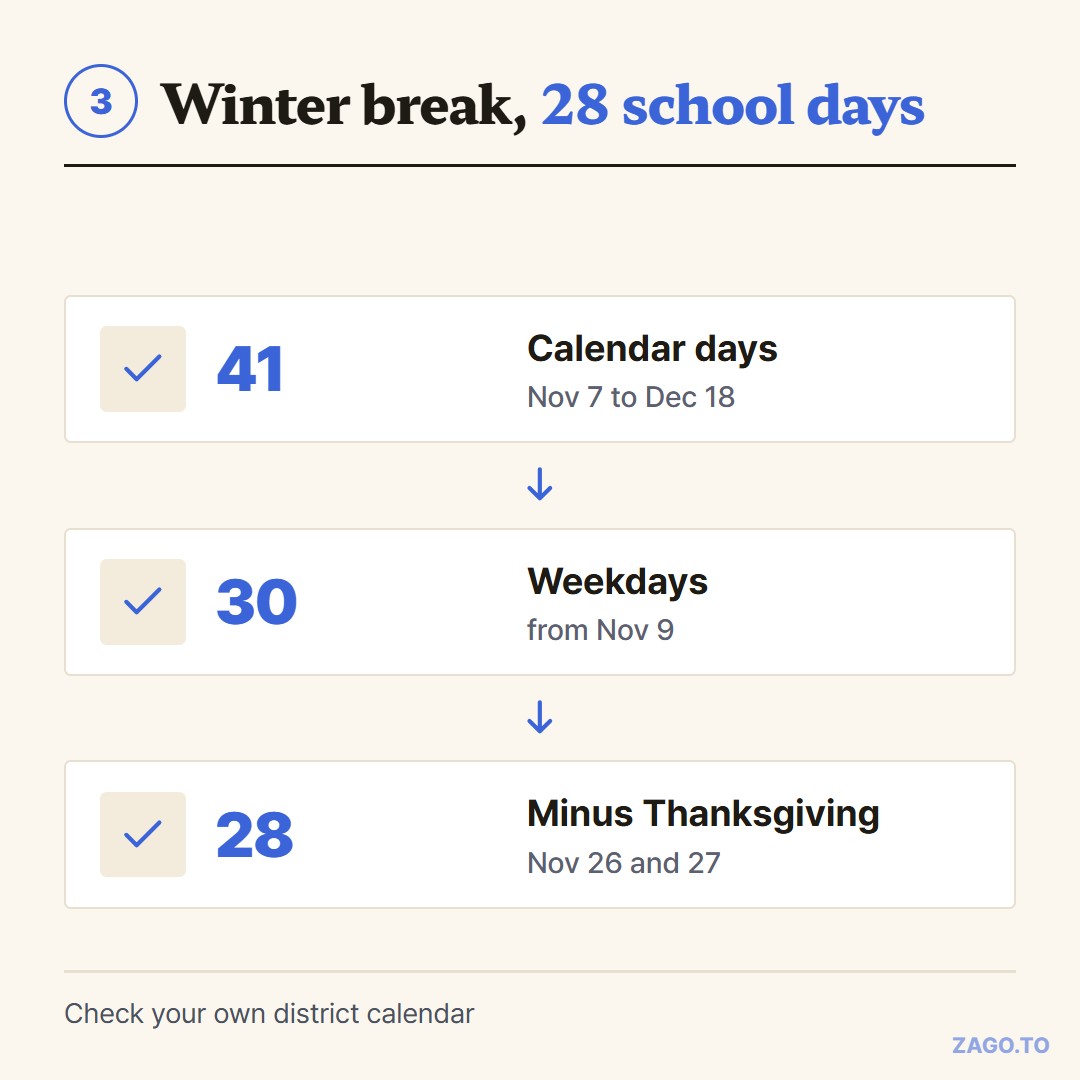
▲ The calendar count and the school-day count are far apart
That number is the one students and teachers tend to care about. A plain calendar count overstates the wait by nearly half.
4. Winter in the Southern Hemisphere
If you are in Australia, New Zealand, South Africa or Argentina, December is summer.
- Meteorological winter there starts on June 1, 2027
- Astronomical winter starts at the June solstice, on June 21, 2027
That is why "first day of winter 2026 Australia" shows up in autocomplete. For the Southern Hemisphere, winter 2026 already happened between June and August.
The UK and Canada follow the Northern Hemisphere dates above. The UK's Met Office uses December 1 for meteorological winter, and the solstice there falls at 8:50 p.m. GMT on December 21.
5. Keep the countdown on your phone
Doing date math in your head works once. When you want the number every morning, a saved countdown is easier.
On ZAGO.TO, the Days Until page lets you name a date, save it on your phone and see the count each time you open the page.
- Type a name, such as "Winter solstice" or "Last day before break"
- Pick the date: December 21, 2026, or your district's last day
- Save it. It sits alongside any other countdowns you have
It also shows weekdays and weekends left, which is the quick way to get the school-day figure from section 3.
Weekday totals include today but not the target date, and holidays are not removed, so subtract Thanksgiving yourself.
What it does not do: it has no built-in "winter" preset, and it will not know your school district's calendar. The countdowns are saved only on the device you used, so a second phone starts empty.
If Christmas is the date you are really counting to, there is a ready-made Christmas countdown that rolls over to next year on its own.
For the full weekday breakdown, see days until Christmas 2026, with weekdays left.
The other end of winter is covered in how many days until spring 2027.
Quick answers
Is December 21 always the first day of winter? No. The solstice moves between December 20 and 23 depending on the year and your time zone.
December 21 is the most common date in recent decades, and it is the date in 2026 for the whole United States.
When is the next Winter Olympics? The 2026 Winter Games in Milan and Cortina finished in February 2026. The next ones are in the French Alps in 2030.
What is the darkest day of winter 2026? The day with the least daylight is December 21. The darkest evening comes earlier in December, and the darkest morning later, in early January.
For a countdown that updates itself, save the date in Days Until and check it whenever you like.
Other tools: Age Calculator · Wheel Spinner
 Days until Christmas
 Word Counter
 Age Calculator
 Wheel Spinner